Guide to Obtaining a Spouse Visa for a Japanese National by Marriage
Last Updated:
Guide to Obtaining a Spouse Visa for a Japanese National by Marriage
The status of residence that a foreign spouse married to a Japanese national typically considers in order to live in Japan is the Status of Residence: “Spouse or Child of Japanese National”, commonly referred to as the “Spouse Visa for a Japanese National.”
However, the best procedure for a spouse visa differs depending on where you currently live (overseas or in Japan) and the foreign spouse’s current status of residence (Temporary Visitor, Student, Work, etc.). This page organizes the procedures by situation so you can move forward without confusion and proceed to the relevant detailed pages.
- What Is the Spouse Visa for a Japanese National by Marriage?
- Eligibility Requirements for Obtaining a Spouse Visa (Marriage)
- Typical Pathways and Procedures to Obtain the Spouse Visa
- Application Flow and Immigration Screening Period
- Required Documents for a Spouse Visa Application
- Approval Case Examples: Spouse Visa by Marriage
- Q&A on Spouse Visa Applications
- We got married while living overseas. If we return to Japan, what is the most common way to obtain a spouse visa?
- Can I enter Japan as a Temporary Visitor and then change to a spouse visa after returning?
- We just got married and our income is low. Can we still obtain a spouse visa for a Japanese national?
- I married while staying in Japan on a Student or Work visa. Can I change to a spouse visa without leaving Japan?
- What benefits do I get after obtaining a spouse visa for a Japanese national?
- Spouse Visa Application Support Service
- Service Overview
- What the Service Includes
- Why Choose ACROSEED Immigration Lawyer's Office
- Google Reviews
- Service Fees
- Other Popular Pages Related to Obtaining a Spouse Visa
1. What Is a Spouse Visa for a Japanese National by Marriage?

When a foreign national marries a Japanese national and builds a life together in Japan, it is common to apply at immigration (the Immigration Services Agency of Japan) for the Status of Residence: “Spouse or Child of Japanese National”. This status is commonly referred to as a “Spouse Visa” or “Spouse Visa for a Japanese National.”
In Appendix Table 2 of the Immigration Control and Refugee Recognition Act, “Spouse or Child of Japanese National” is defined as follows regarding a person’s status or position in Japan.
Spouse of a Japanese national, special adopted child, or a person born as a child of a Japanese national
Source: Immigration Act Appendix Table 2, “Spouse or Child of Japanese National”
In other words, “Spouse or Child of Japanese National” includes: (1) a spouse married to a Japanese national, (2) a special adopted child of a Japanese national, and (3) a person born as a child of a Japanese national. However, on this page we focus on “a foreign spouse married to a Japanese national” and explain the key points for obtaining this status in a clear way.
Because the Status of Residence “Spouse or Child of Japanese National” is commonly referred to as a “Spouse Visa,” we will use the term “Spouse Visa” below.
Who Qualifies as a “Spouse” Under Immigration Law? (Substance matters, not just form.)
A spouse visa is not automatically granted simply because your marriage registration is accepted and you are legally married. Japanese case law, including Supreme Court precedent, indicates that in addition to a legally valid marriage, the substance of the marriage (the reality of living together as a couple) is an important factor for eligibility.
A. To reside in Japan with the status of residence “Spouse or Child of Japanese National,” it is not sufficient merely to have a legally valid marriage with a Japanese spouse.
Source: Eligibility for status of residence for a person intending to engage in activities as a spouse (Supreme Court judgment, October 17, 2002)
B. It is understood to be based on the intention to engage in activities in Japan as a person who has a special status relationship of marriage with a Japanese spouse—namely, living together with sincere intent for a permanent mental and physical union.
Here, “spouse” refers to a person who is currently in a valid marriage. Therefore, in principle, after divorce or the death of a spouse, you are no longer treated as a “spouse” for this status (and you may need to consider a different status of residence).
In addition, to be granted residence as a spouse, it is necessary that the marriage is legally valid under the laws of both countries of nationality. Furthermore, because the relationship must also be recognized as a marriage in Japan, common-law marriage (de facto marriage) is not eligible.
The most important point is the “substance” of the marriage. Even if the marriage is legally valid, if there is no evidence of a real marital life— that is, if it is judged that cohabitation, mutual support, and the ordinary realities of married life are not present— you may not be recognized as a person “engaging in activities as a spouse of a Japanese national,” and eligibility for the status of residence may be denied.
Generally, unless there is a reasonable explanation, living together is an important factor in demonstrating a genuine marriage. However, there are cases where living separately is unavoidable due to work (temporary assignment), study, caregiving, or preparation for childbirth. In such cases, it is important to consistently explain the marital reality, including the reason for living separately, the actual communication/visits, and how living expenses are shared.
2. Eligibility Requirements for Obtaining a Spouse Visa (Marriage)

In screening a spouse visa for a Japanese national (Status of Residence: “Spouse or Child of Japanese National”), immigration does not look only at whether your marriage registration has been accepted. Instead, it makes a comprehensive assessment of “legal validity of the marriage,” “substance of the marriage,” and “a stable basis of life in Japan.”
The main requirements organized from case law and current immigration practice are as follows.
- You are currently in a valid marriage (common-law/de facto marriage is not included).
- The marriage is legally valid in Japan and under the laws of both parties’ home countries.
- The marriage is not merely formal; it is supported by real substance such as cohabitation and a track record of interaction.
In particular, the substance of the marriage is checked in detail through the questionnaire that immigration may request you to submit.
Specifically, immigration often examines the following from multiple angles.
- Whether there are any unnatural aspects in the relationship history from meeting to marriage
- Whether family/relatives/friends recognize the marriage
- How you overcome language/cultural differences (actual communication)
- Whether you live together; if not, whether there is a reasonable explanation
These are confirmed to prevent so-called “sham marriages,” and immigration places importance not on a single factor but on the overall consistency.
In addition to marital substance, the following points are also important in screening.
- Economic stability and compliance with public obligations
Whether you can maintain a stable and continuous life as a couple in Japan is a key factor in spouse visa screening.
There is no fixed minimum annual income requirement, but immigration makes a comprehensive evaluation based on salary income as well as savings, rental income, and planned support from relatives.
In recent practice, immigration has tended to place more emphasis not only on income amount but also on whether you properly fulfill public obligations such as taxes, pension, and health insurance premiums.
- Status of filing and payment of resident tax and income tax
- Enrollment and payment status for the National Pension / Employees’ Pension
- Enrollment and payment status for health insurance (National Health Insurance / Social Insurance)
If there are unpaid or delinquent amounts, even if the marriage is recognized as genuine, it may still be evaluated negatively regarding “whether you can maintain a stable life in Japan.”
Even if you have just returned to Japan and have not yet started working, approval may still be possible if you can reasonably explain your situation with documents such as an employment offer letter, a certificate of expected employment, or planned financial support from parents.
- Past stay history and legal compliance of the foreign spouse
If there are issues in the foreign spouse’s past stay history in Japan—such as illegal stay, unauthorized work, deportation history, or involvement in criminal matters—it can significantly affect the screening.
In many cases, the Japanese spouse may not have been aware of such facts and learns them only after hearing the explanation for the refusal decision.
If you have concerns about past stay history, it is important to organize the facts in advance and carefully consider how to explain them.
For more details on eligibility requirements and screening standards, please see the following page.

Eligibility Requirements and Screening Standards for the Spouse Visa for a Japanese National
An immigration lawyer explains, based on practical experience, the eligibility requirements and screening standards for obtaining a spouse visa for a Japanese national through international marriage.
3. Spouse Visa for a Japanese National | How to Choose the Right Application Route
The spouse visa for a Japanese national (Status of Residence: “Spouse or Child of Japanese National”) requires a different application route depending on where the foreign spouse is currently located and what status of residence they are staying under.
Even if the fact of marriage is the same, the starting point of the application (overseas or in Japan), the type of status of residence, and the order of procedures can greatly change the required documents, screening focus, and risks.
When obtaining a spouse visa through marriage, cases generally fall into the following three categories.
- The couple is living overseas and plans to return to Japan together.
- The Japanese spouse is living in Japan and invites the foreign spouse from overseas.
- The foreign spouse is already living in Japan and obtains the visa through a change of status of residence.
Below, we organize the “starting point of thinking” and a typical procedural flow for each case and guide you to the detailed explanation pages.
1. How Couples Living Overseas Can Obtain a Spouse Visa for a Japanese National
This case applies when both spouses live overseas and want to start living together in Japan.
In practice, two methods are commonly chosen in this situation.
- (A) Obtain a COE while living overseas and return to Japan together
- (B) Enter Japan first as a Temporary Visitor and change to a spouse visa in Japan
(A) Apply for a COE while living overseas, then return to Japan together after it is issued
While the foreign spouse remains overseas, you obtain a Certificate of Eligibility (COE) before entry, and then the couple returns to Japan together.
- Because mid- to long-term residence is assumed from the time of entry, stability is high.
- Cooperation from an applicant/proxy in Japan (such as a relative) is necessary.
For detailed procedures and cautions, please see the following page.
How to Successfully Relocate to Japan with a Foreign Spouse
This page explains in detail the process of obtaining a COE while living overseas and returning to Japan together under a spouse visa for a Japanese national.
(B) Enter Japan as a Temporary Visitor upon return and change to a spouse visa
The foreign spouse comes to Japan under Temporary Visitor status (short-term visa / visa waiver), prepares to start life in Japan, and applies to change the status of residence to “Spouse or Child of Japanese National.”
Under the Immigration Act, changing from Temporary Visitor to a mid- to long-term status of residence such as a work visa or spouse visa is generally not permitted.
However, in practice, there are cases where an exception is granted only when factors such as the genuineness of the marriage, a stable basis of life, and a reasonable purpose for entry are well established.
- No need for a proxy applicant in Japan (such as a relative).
- Eligibility varies greatly by case, so advance planning is essential.
For details and cautions of this method, please see the following page.
How to Enter as a Temporary Visitor and Change to a Spouse Visa
This page explains the exceptional cases where a change from Temporary Visitor to a spouse visa may be permitted and the key cautions when applying.
2. When a Japanese Spouse Living in Japan Invites a Foreign Spouse Living Overseas
This case applies when the Japanese spouse already lives in Japan and invites the foreign spouse who is overseas to Japan.
In principle, in this case, you apply for a Certificate of Eligibility (COE) from Japan.
- The Japanese spouse becomes the applicant (or acts as a proxy applicant).
- The genuineness of the marriage and the basis of life in Japan (income and housing) are screened.
- After the COE is issued, the foreign spouse applies for a visa at a Japanese embassy/consulate overseas.
The clearer the Japanese spouse’s income and housing situation, the more smoothly screening tends to proceed.
The detailed flow for this case is explained on the following page.
How to Invite a Foreign Spouse Living Overseas with a COE
This page explains the standard procedure of applying for a COE from Japan and bringing your overseas spouse to Japan.
3. When the Foreign Spouse Is Already Living in Japan (Change of Status of Residence)
This case applies when the foreign spouse is already residing in Japan and switches from another status of residence (such as Student or Work) to a spouse visa for a Japanese national.
Common patterns include the following.
- Change from a Student visa to a spouse visa for a Japanese national
- Change from a Work visa to a spouse visa for a Japanese national
In this case, by filing an application for permission to change status of residence, it is possible to complete the procedure entirely within Japan.
On the other hand, because immigration carefully checks the consistency between the activities under the current status of residence and the timing of marriage / start of cohabitation, careful application design may be required depending on the case.
For details on obtaining the visa via change of status, please see the following page.
How to Change from Student/Work Visa to a Spouse Visa for a Japanese National
This page explains the key screening points when changing from Student/Work and other statuses to a spouse visa for a Japanese national.
4. If You Are Unsure Which Application Route to Choose
When applying for a spouse visa through marriage, the outcome is influenced not only by whether you are married, but also by which application route you choose.
Even for the same couple, depending on whether you live overseas or in Japan, what the current status of residence is, and when and in what order you apply, the screening focus and risks can change significantly.
In particular,
- When it is difficult to judge whether you can change from Temporary Visitor to a spouse visa
- When timing such as return to Japan, starting employment, and beginning cohabitation are interrelated
- When there are concerns about income, housing, or family structure
In such cases, it can happen that “approval may have been possible, but choosing the wrong application route leads to a refusal”.
Determining the appropriate route requires not only the legal principles, but also case-specific judgment based on immigration practice.
At ACROSEED Immigration Lawyer's Office, immigration lawyers experienced in spouse visa practice will propose the best application method tailored to your situation. Please feel free to contact us.
Please tell us your current situation (living overseas, living in Japan, change of status, etc.).
Even if you are concerned about income or cohabitation, we will provide concrete guidance on how to proceed toward approval.
Support is available in English and Chinese.
Email Consultation 03-6905-6371
4. Application Flow for the Spouse Visa for a Japanese National & Immigration Screening Period
1. Procedure to Bring Your Spouse to Japan from Overseas
When inviting a spouse who is overseas to Japan, you will apply for a document issued by Japan’s Immigration Bureau called a “Certificate of Eligibility.”
This certificate is issued after Japan’s Immigration Bureau examines, before the spouse’s entry, whether the spouse qualifies as “Spouse or Child of Japanese National,” and approval is granted. Therefore, when you apply for a marriage visa at a Japanese embassy or similar overseas using this certificate, the visa is generally issued within a few days.
When you enter Japan with that visa, you will be granted the status of residence “Spouse or Child of Japanese National” at the time of entry inspection.
-
1
- Free Consultation
We will confirm whether it is possible to obtain approval for an application for the Certificate of Eligibility for the status “Spouse or Child of Japanese National,” and if there are issues, how far they can be corrected.
Consultations are available via (1) phone, (2) email, (3) online (Skype, Zoom, LINE, WeChat), or (4) in-person at our office. Please contact us first by phone or email.
-
2
- Engagement of Services
- If you wish to retain our services, we will execute an agreement and begin work once payment is received.
-
3
- Preparation of Application Documents
- Based on past experience, we will prepare and create the documents we believe will maximize the likelihood of approval. After you review the documents we prepared, we will ask you to sign where required.
-
4
- Filing the Application at Immigration on Your Behalf
- On your behalf, an immigration lawyer from ACROSEED Immigration Lawyer's Office will file the application at immigration. (Estimated screening period: about 1 to 3 months)
-
5
- Delivery of the Certificate of Eligibility
- After screening is completed, the Certificate of Eligibility (COE) will be mailed from immigration to ACROSEED Immigration Lawyer's Office.
-
6
- Send to the Foreign Spouse Living Overseas
- After receiving the Certificate of Eligibility (COE), the client sends it to the foreign spouse living overseas by EMS or similar service.
-
7
- Send to the Foreign Spouse Living Overseas
- After receiving the Certificate of Eligibility (COE), the client sends it to the foreign spouse living overseas by EMS or similar service.
-
8
- Visa Issuance at the Local Japanese Embassy
- After receiving the Certificate of Eligibility (COE) overseas, the foreign spouse applies for a visa at the nearest Japanese embassy. In most cases, the desired visa is issued in about 1 to 2 weeks. (*1)
-
9
- Entry into Japan
- At the airport in Japan, you present the visa at entry inspection and enter Japan after being granted the desired status of residence. (*2)
2. When You Marry a Foreign Spouse Who Is Already in Japan
If the foreign spouse is already in Japan, the following cases may apply.
2. A case where the spouse already has a spouse visa from a previous marriage and no procedures are required until the next renewal
3. A case where the spouse entered on a tourist visa and changes to a spouse visa
For method 3 (changing to a spouse visa after entering on a tourist visa), there are various restrictions under the current immigration system, and if handled incorrectly it may lead to illegal overstay. Therefore, a detailed discussion in advance is necessary.
-
1
- Free Consultation
We will confirm whether it is possible to obtain a spouse visa for a Japanese national and, if there are issues, how far they can be corrected.
Consultations are available via (1) phone, (2) email, (3) online (Skype, Zoom, LINE, WeChat), or (4) in-person at our office. Please contact us first by phone or email.
-
2
- Engagement of Services
- If you wish to retain our services for obtaining a spouse visa, we will execute an agreement and begin work once payment is received.
-
3
- Preparation of Application Documents
- Based on past experience, we will prepare and create the documents we believe will maximize the likelihood of approval for your case. After you review the documents we prepared, we will ask you to sign where required.
-
4
- Filing the Application at Immigration on Your Behalf
- On your behalf, an immigration lawyer from ACROSEED Immigration Lawyer's Office will file the application at immigration. (Estimated screening period: about 1 to 2 months)
-
5
- Obtaining Approval on Your Behalf
- The approval notice will be delivered to ACROSEED Immigration Lawyer's Office. On your behalf, an immigration lawyer will complete the endorsement procedure at immigration.
-
6
- Return of Residence Card and Passport
- We will return the documents we held, such as the residence card and passport, and the service will be completed.
3. Typical Screening Period for Spouse Visa Applications
The screening period is published with monthly updates. Please check the latest average processing days at the link below.
5. Required Documents for a Spouse Visa Application
Because required documents frequently change due to legal amendments and other updates, please check the latest information on the Immigration Services Agency of Japan website.
If you retain our services, we will prepare the set of documents that we believe will maximize the likelihood of approval, based on the required documents listed on the Immigration Services Agency website and tailored to your specific circumstances.
1. Required Documents When Applying for “Spouse or Child of Japanese National” via a Certificate of Eligibility (COE) Application
(Immigration Services Agency of Japan website)
2. Required Documents When Applying for “Spouse or Child of Japanese National” via an Application for Permission to Change Status of Residence
(Immigration Services Agency of Japan website)
3. Required Documents When Applying for “Spouse or Child of Japanese National” via an Application for Extension of Period of Stay
(Immigration Services Agency of Japan website)
6. Approved Case Examples: Spouse Visa for a Japanese National Through Marriage
Even in international marriages, approval or refusal for a spouse visa for a Japanese national may differ depending on the circumstances. Here, we introduce representative approved cases that ACROSEED Immigration Lawyer's Office has supported.
1. Case: A Couple Living Overseas Obtained a Certificate of Eligibility (COE) Locally and Returned to Japan
 |
Client (from Google Reviews) |
| [Approved Case] Obtaining “Spouse or Child of Japanese National” by applying for a Certificate of Eligibility (COE) from overseas |
2. Case: Entered Japan on a Short-Term Visa and Then Changed to “Spouse or Child of Japanese National”
|
VOL.157 Mr./Ms. K (China) |
| Case where a change of status to “Spouse or Child of Japanese National” was approved after entering Japan as a Temporary Visitor (short-term visa) |
3. Case: Invited a Spouse to Japan Using a Certificate of Eligibility (COE) for “Spouse or Child of Japanese National”
 |
VOL.177 Mr./Ms. M (Tunisia) |
| [Approved Case] The spouse living in Japan applied for a COE and invited their spouse from overseas |
4. Case: Obtained “Spouse or Child of Japanese National” (or “Spouse or Child of Permanent Resident”) Through a Change of Status
 |
VOL.40 Ms. Asami, Mr./Ms. Gao (China) |
| [Approved Case] A change of status from a Student visa to “Spouse or Child of Japanese National” was approved |
See More Approved Spouse Visa Case Examples
Even if you cannot find a case example similar to your situation, there are many cases where approval is achieved through how the documents are structured and how explanations are crafted. If you feel uncertain, please organize your situation once through a free consultation.
Please tell us your current situation (living overseas, living in Japan, change of status, etc.).
Even if you are concerned about income or cohabitation, we will provide concrete guidance on how to proceed toward approval.
Support is available in English and Chinese.
Email Consultation 03-6905-6371
7. Q&A on Spouse Visa Applications for a Japanese National
When both spouses are living overseas, the most common approach is to obtain a Certificate of Eligibility (COE) while remaining overseas, and then return to Japan together.
With this approach, you can reside in Japan under a mid- to long-term status (“Spouse or Child of Japanese National”) from the moment you enter Japan. This makes it easier to proceed promptly with post-entry procedures such as resident registration, opening a bank account, and enrolling in health insurance.
On the other hand, based on our practical experience, among clients who retain our office, the cases are roughly split 50/50 between “obtaining a COE overseas” and “entering Japan as a Temporary Visitor and then changing status”.
A change of status from Temporary Visitor is treated as an exceptional handling under the Immigration Act, so it is not approved in every case. However, depending on circumstances such as the timing of marriage, actual cohabitation, and the level of preparation for life in Japan, it may become a realistic option in some cases.
Therefore, rather than choosing an application route solely because “it’s common” or “it was on the internet,” it is important to organize your situation in advance and proceed with the method that fits your circumstances.
Changing from Temporary Visitor status (short-term visa / visa waiver) to a spouse visa for a Japanese national is generally not permitted under the Immigration Act.
However, in practice,
- the genuineness of the marriage is clearly established
- there is a reasonable purpose for entry and a reasonable background for returning to Japan
- the basis of life in Japan is already in place
and only when such factors are well satisfied, there are cases where an exceptional change is approved.
Because eligibility varies greatly depending on the case, if you are considering entering Japan as a Temporary Visitor, you need to carefully examine the application route in advance.
There is no clearly defined minimum annual income requirement for spouse visa screening. What matters is whether the couple can maintain a stable life in Japan.
Even if salary income is low,
- you have savings
- you have a job offer / expected employment
- support from family is expected
such factors are considered in a comprehensive manner.
In addition, in recent years, whether you properly fulfill public obligations such as taxes, pension, and health insurance premiums has also become an important factor. So it is essential to organize the overall life plan rather than judging only by income amount.
If the foreign spouse is already residing in Japan, it is possible to switch to a spouse visa for a Japanese national within Japan by applying for permission to change status of residence.
However, immigration will carefully examine the consistency between the activities under the current status of residence and the circumstances leading to marriage and the timing of starting cohabitation.
For example, if there is little evidence of genuine study during a Student status period before marriage, or if there is a gap between the Work status activities and actual living circumstances, a careful and detailed explanation will be required.
A key feature of the spouse visa for a Japanese national is that there are no work restrictions, and you can work regardless of job type or work style.
In addition,
- there are no restrictions on changing jobs or becoming self-employed
- long-term residence is possible through renewals
- if you meet the requirements, it can lead to permanent residency or naturalization applications
These are also major benefits.
For those who want to build a stable life in Japan through marriage, a spouse visa for a Japanese national is a highly flexible status of residence.
8. Spouse Visa Application Support Service (Marriage-based Spouse Visa for a Japanese National)
1. Service Overview
This service provides end-to-end support by ACROSEED Immigration Lawyer's Office for foreign spouses who married a Japanese national to obtain and renew the status of residence “Spouse or Child of Japanese National”.
In screening for a spouse visa through marriage, it is necessary to explain comprehensively the genuineness of the marriage, stability of life, and your future life plan. In many cases, approval is not achieved simply by collecting the documents.
Based on our extensive approval track record, ACROSEED Immigration Lawyer's Office designs the optimal application route and evidence strategy tailored to each client’s situation and conducts an application that maximizes the approval probability.
We support cases such as the following:
・Entering Japan as a Temporary Visitor and changing to a spouse visa within Japan
・Changing from Student/Work and other statuses to a spouse visa for a Japanese national
・Aiming for more stable periods of stay upon renewal (e.g., 1 year → 3 years)
We can also advise on mid- to long-term residence planning, including renewals, permanent residency applications, and naturalization after obtaining the spouse visa.
2. What the Service Includes
- Designing an application strategy that maximizes approval likelihood according to your circumstances
- Drafting and structuring statements of reasons, explanatory letters, and supplementary materials
- Filing the application with the Immigration Services Agency and handling endorsement procedures on your behalf
- Progress management during screening and responding to requests for additional documents
- Free re-application support if the application is refused
- Mid- to long-term advice with renewals, permanent residency, and naturalization in mind
3. Benefits of Hiring ACROSEED
In spouse visa screening, the consistency and persuasiveness of background explanations—such as “how you came to marry” and “how you will live together”—are critical. At ACROSEED Immigration Lawyer's Office, we do not treat each document in isolation; we design the application as a coherent story that is easy for the examiner to assess. Another key strength is that we proceed with the application after building a realistic residence plan, keeping renewals, permanent residency, and naturalization in view.
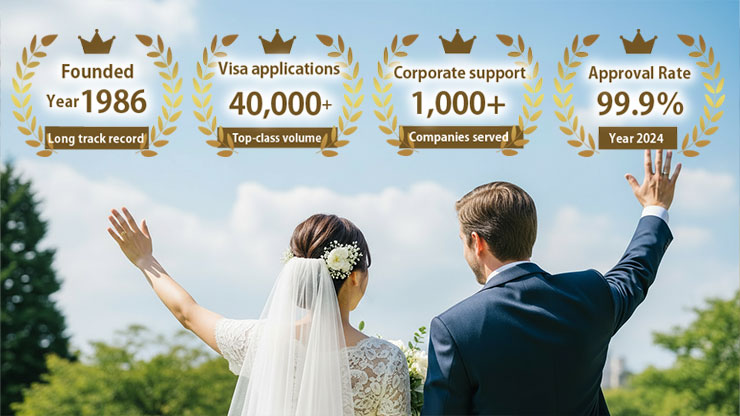
Founded in 1986 — Over 40,000 Visa Cases
We apply long-term screening insight and corporate-level standards to your individual case.
Learn MoreVeteran Immigration Specialists (10+ Years)
Experts who understand screening criteria reduce refusal risks through consulting.
Learn MoreCentralized Headquarters System
No dispersed standards — decisions reflect accumulated experience and current trends.
Learn MoreMultinational Staff Offering Practical Multilingual Support
Not interpreters — but practitioners who understand visa evaluation points in English/Chinese.
Learn MoreOnline Progress Management System
Real-time status, document tracking, and uploads reduce inquiry stress.
Learn More99.9% Approval Rate (2024)
We decline applications when approval prospects are extremely low — honesty first.
Learn MoreTraining + Compliance (ISO27001)
Quality and information security are systemized for long-term client trust.
Learn MoreFree Consultation to Assess Possibility & Challenges
We clarify approval prospects, risks, and preparation priorities.
Learn MoreFlat Nationwide Pricing — Fully Transparent
Same standards anywhere in Japan. No hidden charges or mid-process fee increases.
Learn More▼See the 9 Reasons ACROSEED Is Chosen for More Details
View ACROSEED’s Track Record
View Customer Testimonials & Approved Case Collection
4. Ratings in Google Reviews
ACROSEED Immigration Lawyer's Office has received strong evaluations from many clients regarding service quality in various visa applications, including spouse visas for Japanese nationals.
5. Service Fees for Spouse Visa Applications for a Japanese National
• There are absolutely no additional fees depending on your conditions.
• ACROSEED Immigration Lawyer's Office provides nationwide support. Clients outside the area may also retain our services at the fees below.
• Payment by Visa and MasterCard is also available.

| Inviting a spouse from overseas under a spouse visa for a Japanese national Certificate of Eligibility (COE) Application |
150,000 JPY |
|---|---|
| Application for Permission to Change Status to a Spouse Visa for a Japanese National | 150,000 JPY |

ACROSEED Immigration Lawyer's Office
Representative Administrative Scrivener
Makoto Sano
1998 Graduated from Aoyamagakuin University
2001 Registered as an administrative scrivener
He has Over 20 years of experience as an international administrative scrivener, specializing in foreign employment consulting and residence procedures for foreign residents in Japan.
Click here to see information about his business achievements
Click here to see books he has authored
Pages Often Read Together When Applying for a Spouse Visa of a Japanese National
![[FY2025 Edition] Spouse Visa of a Japanese National (Marriage Visa) Application Guide](https://english.visajapan.jp/images/haigusha_title.jpg)
[FY2025 Edition] Spouse Visa of a Japanese National (Marriage Visa) Application Guide
An administrative scrivener explains the requirements for obtaining a spouse visa (marriage), working under a spouse visa, applying for permanent residency from a spouse visa, what happens in the event of divorce under a spouse visa, required documents, and more.
![[FY2025 Edition] Spouse Visa of a Japanese National Renewal Procedures Guide](https://english.visajapan.jp/images/spouse_renewal_title.jpg)
[FY2025 Edition] Spouse Visa of a Japanese National Renewal Procedures Guide
Renewal procedures for a Spouse Visa of a Japanese National (Marriage Visa). An administrative scrivener explains the required document checklist, how to avoid denial cases, and key points to prove eligibility for obtaining a 3-year or 5-year period of stay.

Applying for Permanent Residency from a Spouse Visa of a Japanese National
At ACROSEED, we have a proven track record not only with first-time spouse visa applications, but also with cases that were denied multiple times when filed by the applicant alone, as well as procedures for those with past legal violations or a history of overstaying—across a wide variety of situations.
For More Detailed Questions About the Spouse Visa System
Please explain the requirements for obtaining a Spouse Visa of a Japanese National in detail
Periods of stay for a Spouse Visa of a Japanese National: Differences between 1 year, 3 years, and 5 years
Required documents & Statement of Reasons for a Spouse Visa of a Japanese National: Key examination points and preparation tips (Latest Edition)
How to invite a foreign spouse living overseas to Japan with a COE
Can we apply for a Certificate of Eligibility while both spouses remain overseas?
Changing from a short-term visa to a Spouse Visa of a Japanese National: General rules and exceptions
How to change from a student/work visa to a spouse visa
My spouse visa application was denied (COE not issued). Can I re-apply?
Since opening our practice in 1986, we have been involved in consulting on visa applications for foreigners for nearly 40 years as an immigration lawyer.
Telephone consultation, email consultation, online consultation, and consultation at our office are available.