For Those Preparing to Renew Their Status of Residence | A Complete Guide to Renewal Procedures
Last updated:
Status of Residence Renewal Guide
When the expiration date of a period of stay approaches, many foreign residents apply for a “status of residence renewal.” In most cases, if there have been no significant changes in the type of status or the activities carried out, renewal applications are approved without major issues.
However, renewal is not merely a procedure to extend the period of stay. It is also a review process in which immigration authorities reconfirm whether the applicant continues to engage in the same activities permitted under the current status of residence. Before moving into explanations of individual visa types, this page organizes the common principles and important points applicable to all status of residence renewals.
- What Is Status of Residence Renewal? (Overall Framework to Understand First)
- Common Points That Must Be Organized Before Renewal
- Cases That Are למעשה Closer to a Change of Status Than a Renewal
- Key Points for Aiming for Long-Term Permissions Such as 3 or 5 Years
- Renewal Pages by Status of Residence
- Work Visa Renewal
- Engineer / Specialist in Humanities / International Services Visa Renewal
- Highly Skilled Professional (HSP) Renewal
- Intra-Company Transferee Visa Renewal
- Business Manager Visa Renewal
- Spouse of Japanese National Visa Renewal
- Dependent Visa Renewal
- Important Renewal Considerations with Future Permanent Residence in Mind
- Support System of ACROSEED Immigration Lawyer's Office
1. What Is Status of Residence Renewal? (Overall Framework to Understand First)
Status of residence renewal is a procedure to extend the period of stay based on the premise that the applicant will continue engaging in the same activities permitted under the currently approved status of residence. Accordingly, immigration authorities commonly review the following points.
- Whether the current activities fall within the purpose and scope of the status of residence
- Whether there are any issues with the applicant’s residence status (notifications, tax payments, social insurance, etc.)
- Whether there have been any major changes since the previous approval
By first clarifying “which status of residence you are renewing” and “what has changed since the previous approval,” the direction of your renewal preparation becomes much clearer.
2. Common Points That Must Be Organized Before Renewal
In status of residence renewal, immigration authorities focus not only on the applicant’s situation at the time of application, but also on what changes have occurred since the previous approval. The review is conducted from the perspective of whether the applicant’s residence in Japan has been stable and continuous over time, rather than simply whether there are no current problems.
Therefore, renewal preparation is not just about collecting required documents. It is essential to organize the differences from the previous approval and identify points that require explanation.
1. Changes in Activities or Job Duties
- Whether there have been changes in job duties, responsibilities, or roles
- Whether the level of specialization or position within the company has changed
- Whether there is any mismatch between the permitted activities and actual work performed
For work-related statuses of residence, the specific nature of the work performed forms the basis of the review. Even if you are employed by the same company, changes in duties or responsibilities may be re-examined at the time of renewal.
In particular, if the proportion of managerial duties has increased, or if your role has shifted from on-site work to planning or supervisory functions, it is important to organize how your activities remain consistent with your status of residence.
2. Changes in Employment Conditions and Income
- Whether there have been significant increases or decreases in annual or monthly income
- Whether the proportion of bonuses or incentive-based pay, or the compensation structure, has changed
- Whether there have been changes in employment type (full-time, contract-based, etc.) or contract terms
- Whether your current income allows you to maintain a stable life
In renewal examinations, immigration authorities consider not only the amount of income, but also its stability. Even if there has been a temporary decrease in income or a system change, it does not necessarily become a disadvantage if the background and future outlook are properly organized.
However, if numerical changes are presented without explanation, it may make it difficult for the examiner to assess the situation. Therefore, when changes exist, it is important to clearly organize the reasons and current circumstances.
3. Confirmation of Residence Status and Living Conditions
- Whether there are any unpaid or delayed payments of resident tax, income tax, or social insurance
- Whether notifications such as changes of address or affiliated organization have been properly submitted
- Whether there have been changes in living circumstances, such as marriage, childbirth, or changes in dependents
Although often overlooked in renewal applications, tax payments and compliance with social insurance are important factors in determining the stability of residence. Even if they do not cause issues at the renewal stage, they may affect future permanent residence applications.
Changes in address or family composition are also reviewed, including whether the required notifications were properly filed, so organizing this information in advance provides peace of mind.
Even if changes exist in these areas, they do not automatically place the applicant at a disadvantage. What matters most is whether you can clearly explain why the changes occurred and whether your current situation is stable.
3. Cases That Are למעשה Closer to a Change of Status Than a “Renewal”
As the end of your period of stay approaches, many people assume, “I can proceed with a renewal again this time.” In fact, if there have been no major changes in the type of status of residence or the activities you engage in, most cases can be handled through renewal.
However, depending on what has changed since the last approval, there are cases where even if it is formally a renewal application, it is considered in substance to be closer to a change of status of residence.
In such situations, if you simply submit the standard renewal documents, the examiner may not be able to accurately understand your current activities, which can lead to a prolonged review process or a more cautious assessment.
-
Cases where the scope of activities or job duties has changed significantly
Example: You previously worked primarily on development as an engineer, but now your work mainly consists of management duties or sales administration. If the essence of your work has changed, you may need to reconsider whether renewal alone is appropriate. -
Cases where the employment arrangement or affiliated organization has changed
Example: You transferred to a Japanese entity, moved to another group company, or switched to an independent contractor agreement, etc., where the employment relationship itself has changed. Not only document organization but also the choice of the proper procedure becomes important. -
Cases where you are engaging in activities that go beyond the framework of the current status of residence
Example: You came to Japan under an Intra-Company Transferee status, but in reality you are in a state of long-term employment by the Japanese entity. It is necessary to confirm whether the underlying premise of the system has changed. -
Cases where you are considering switching to a different status of residence
Example: You are considering moving from Engineer/Specialist in Humanities/International Services to Highly Skilled Professional, or you plan to change from a work-related status to a spouse visa. In some situations, a change-of-status application may be more reasonable than proceeding with renewal.
The key is not to decide “renewal or change” based only on formalities. By organizing your situation from the perspective of which status of residence best fits your current actual activities, you can achieve stable residence that also anticipates future renewals and permanent residence applications.
By pausing once before renewal and organizing your circumstances, you can prevent unnecessary risks and the need to redo procedures.
4. Key Points for Aiming for Long-Term Permissions Such as “3 Years / 5 Years” at Renewal
In status of residence renewal, it is important not only whether renewal is approved, but also which period of stay (1 year, 3 years, 5 years, etc.) will be granted.
Even with the same status of residence and the same renewal application, the granted period can differ depending on your past residence record and how the application content is organized.
In addition, in recent years, as institutional reforms are progressing in the direction of increasing renewal fees for status of residence, the significance of aiming for a long period of stay is increasing also from the viewpoint of reducing the number of renewals themselves.
-
Can you clearly explain the stability of your employment / activities?
Even if you have just changed jobs or have just been reassigned, if the consistency of your job duties and the likelihood of continued work are well organized, a long-term permission becomes more likely to be considered. -
Is there a balance between income and living conditions?
Not only the amount of income, but also whether a stable life can be maintained with the current income, and whether continuity is expected going forward, will be comprehensively assessed. -
Do your activities clearly match the premise of your status of residence?
By organizing your job duties and roles in concrete terms, it becomes easier to convey specialization and necessity, and it becomes easier for the examiner to make a determination. -
Are there no concerns regarding residence status and legal compliance?
Proper payment of taxes and social insurance, and appropriate submission of required notifications, are prerequisite conditions for aiming for a long-term permission.
Since 2025, renewal fees for status of residence have been increased in stages, and it is possible that the burden will rise further due to future reforms. Rather than renewing many times over short periods, securing as long a period of stay as possible in a single renewal is important to reduce time and financial burdens.
Renewal applications are not merely procedures to “pass.” They are also an opportunity to build a residence record that connects to the next renewal and to future permanent residence applications. Designing renewals with the granted period in mind directly contributes to stable medium- to long-term residence.
[Important] Future Policy Trends | Unpaid Insurance Premiums and Taxes Will Significantly Affect Renewals
In recent years, in status of residence examinations, tax payment status and compliance with social insurance premium payments have tended to be emphasized more than ever.
Furthermore, the government has indicated a policy that, with the aim of FY2027, foreign nationals with delinquent insurance premium payments will, in principle, not be granted renewal or change of status of residence.
This may affect not only whether renewal is granted, but also the determination of the period of stay (1 year, 3 years, 5 years). Even if it is not currently considered a major issue, from a future-oriented perspective it is important to organize compliance status starting from the renewal stage.
※ Regarding the latest policy trends, conclusions may differ depending on individual circumstances, so we recommend confirming in advance.
5. Renewal Pages by Status of Residence
The key points and areas of focus in status of residence renewal differ depending on the type of status. For details, please refer to the relevant page below.
6. Renewal Considerations with Future Permanent Residence in Mind
Status of residence renewal is not a procedure that simply ends once approval is granted at that time. The residence history accumulated through each renewal becomes an important basis for determining “how you have continuously resided in Japan” when applying for permanent residence in the future.
In permanent residence examinations, not only the current situation, but also past renewal content and residence history are reviewed, with a comprehensive focus on continuity, stability, and reliability. Therefore, from the renewal stage onward, it is important to organize your application with awareness of “how it will be viewed at the time of permanent residence application.”
-
Consistency of career history and activities
Even if you have changed jobs or job duties, immigration authorities will confirm whether there is reasonable continuity in your expertise and career trajectory. -
Stability of income and living conditions
Not only the annual income amount, but also whether you have been able to maintain a stable life on a continuous basis is emphasized. -
Continuous compliance with tax and social insurance obligations
The status of resident tax, income tax, pension, and health insurance is particularly strictly reviewed in permanent residence examinations.
Even points that did not pose an issue at the time of renewal may later be assessed during permanent residence application as “insufficiently explained” or “difficult to understand in terms of history.”
By organizing your circumstances at each renewal and building a consistent residence history with intention, you significantly increase your chances of obtaining permanent residence in the future.
7. Overview of Status of Residence Renewal Application Support (For Individuals)
1. Service Overview

Status of residence renewal (Application for Extension of Period of Stay) is not merely a formal procedure carried out because the expiration date is approaching. In renewal examinations, immigration authorities comprehensively confirm whether you are continuing to engage stably in the activities permitted under your current status of residence, and whether you are in a position to continue such activities going forward.
One aspect that is often overlooked at the renewal stage is the “points of change” since the previous approval. For example, if there have been changes in your employer, job duties, remuneration, dependent status, or living circumstances, the review tends to become more cautious, with questions such as “Is renewal appropriate?” or “Is this closer to another procedure (such as a change of status)?” Even if you personally believe it is a renewal, insufficiently organized explanations can lead to requests for additional documents or prolonged examinations.
At ACROSEED Immigration Lawyer's Office, regardless of the type of current status of residence, we organize changes since the previous approval, clarify the key issues that need to be explained in the renewal examination, and design an application strategy (order of explanation and presentation of supporting documents) that is more likely to lead to approval. Avoiding situations where “the substance is fine, but the documents fail to convey it” is the key to a smooth renewal process.
In addition, status of residence renewal is an important step that also leads to longer periods of stay (such as 3 or 5 years) and future permanent residence applications. Our office does not treat the current renewal as the sole goal, but places emphasis on renewal planning that anticipates medium- to long-term residence stability (renewals, changes when necessary, and permanent residence).
Eligible Applicants (For Individuals)
- Those who are approaching renewal of their period of stay
- Those who have experienced changes in their employer, job duties, or employment type during their period of stay
- Those whose annual income or compensation structure has changed and are concerned about renewal
- Those who were previously granted a short period of stay and are worried about the upcoming renewal
- Those who wish to stabilize their residence with future permanent residence in mind
- Those who are unsure which renewal page applies, such as spouse visas, dependent visas, or work-related statuses
2. Services Included
- Review of the current status of residence (work-related / spouse / dependent / business manager, etc.) and confirmation of renewal policy
- Identification of changes since the previous approval (employer, job duties, compensation, family status, living conditions, etc.)
- Organization of actual activities (job content, dependent status, etc.) and design of the explanation strategy
- Confirmation and supplementary planning of required documents according to circumstances, such as employment contracts, notices of working conditions, family registers, and resident certificates
- Policy proposal on whether to proceed with renewal or consider other procedures based on the actual situation
- Preparation and review of the complete set of documents required for the Application for Extension of Period of Stay
- Submission代理 of the Application for Extension of Period of Stay to the Immigration Services Agency of Japan
- Response to requests for additional documents during examination and supplementary explanations
- Residence management advice with a view to future renewals, changes of status when necessary, and permanent residence
3. Advantages of Working with ACROSEED Immigration Lawyer's Office
In status of residence renewal examinations, it is not sufficient merely to “live in Japan” or “work in Japan.” Immigration authorities place importance on whether activities consistent with the current status of residence are being continuously carried out, and whether any changes can be explained in a reasonable manner.
At ACROSEED Immigration Lawyer's Office, we carefully organize changes since the previous approval and structure applications in a way that proactively addresses the points immigration officers will review. By avoiding situations where “the substance is fine, but the explanation is insufficient,” we help reduce the risk of additional document requests and prolonged examinations.
In particular, for work-related renewals involving job changes, duty changes, or compensation changes, and for spouse or dependent renewals involving changes in family or dependent status, it is important not only to obtain renewal approval, but also to organize your case so as not to create disadvantages at the next renewal or future permanent residence application. Our office does not focus solely on immediate renewal, but also provides policy proposals that include options leading to medium- and long-term residence stability.
Furthermore, our support is valued because we assist not only with the current renewal, but also from the perspective of building a residence history that will not be disadvantageous at the next renewal or permanent residence application.
Founded in 1986 — Over 40,000 Visa Cases
We apply long-term screening insight and corporate-level standards to your individual case.
Learn MoreVeteran Immigration Specialists (10+ Years)
Experts who understand screening criteria reduce refusal risks through consulting.
Learn MoreCentralized Headquarters System
No dispersed standards — decisions reflect accumulated experience and current trends.
Learn MoreMultinational Staff Offering Practical Multilingual Support
Not interpreters — but practitioners who understand visa evaluation points in English/Chinese.
Learn MoreOnline Progress Management System
Real-time status, document tracking, and uploads reduce inquiry stress.
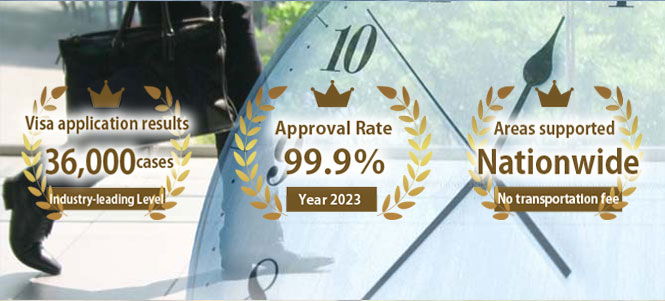
Learn More99.9% Approval Rate (2024)
We decline applications when approval prospects are extremely low — honesty first.
Learn MoreTraining + Compliance (ISO27001)
Quality and information security are systemized for long-term client trust.
Learn MoreFree Consultation to Assess Possibility & Challenges
We clarify approval prospects, risks, and preparation priorities.
Learn MoreFlat Nationwide Pricing — Fully Transparent
Same standards anywhere in Japan. No hidden charges or mid-process fee increases.
Learn More▼Learn more about the 9 reasons ACROSEED is chosen
View ACROSEED’s Track Record
View Client Testimonials and Approved Case Studies
4. Ratings and Reviews on Google
ACROSEED has received high evaluations from many clients regarding the quality of our services, regardless of visa type or nationality.
5. Status of Residence Renewal Support Fees (Excluding Tax)
• There are absolutely no additional charges based on individual circumstances.
• ACROSEED Immigration Lawyer's Office provides nationwide services. Clients outside the area can request services at the same fees listed below.
• Payment by Visa or MasterCard is also accepted.

| Application for Extension of Period of Stay (No changes since the previous application) |
JPY 50,000 |
|---|---|
| Application for Extension of Period of Stay (Changes since the previous application) |
JPY 150,000 |
Since opening our practice in 1986, we have been involved in consulting on visa applications for foreigners for nearly 40 years as an immigration lawyer.
Telephone consultation, email consultation, online consultation, and consultation at our office are available.