Family Dependent Visa: Complete Guide to Bringing Your Spouse and Children to Japan [2026]
Last Updated:
- What Is a Family Dependent Visa? Eligibility for Spouse and Children
- Requirements to Bring Your Spouse and Children (Financial Support Criteria)
- Required Documents for a Family Dependent Visa (Spouse / Child)
- Application Procedure and Examination Process
- Family Dependent Visa Q&A
- Approved Family Dependent Visa Case Studies
- Family Dependent Visa Application Support Services
- Related Pages Commonly Read with Family Dependent Visa
1. What Is a Family Dependent Visa? Eligibility for Spouse and Children
The Family Dependent Visa is a status of residence that allows the spouse and children of a foreign national residing in Japan on a mid- to long-term visa to live together in Japan while being financially supported. It is granted on the premise that the family members live together as dependents, and it is not intended for employment purposes.
Therefore, the approval of a Family Dependent Visa application is primarily determined by two key factors: who you are bringing to Japan and whether you can genuinely support and live together with them in Japan.
1. Eligible Family Members
Under Japanese immigration law, eligible family members for a Family Dependent Visa are limited to the following two categories:
- A legally married spouse of the foreign resident in Japan
- Children who are financially dependent on the foreign resident
The sponsoring foreign resident must hold a valid mid- to long-term status of residence, such as:
- Work visas (Engineer/Specialist in Humanities/International Services, Business Manager, Highly Skilled Professional, Intra-company Transferee, etc.)
- Activity-based visas (Professor, Researcher, Instructor, Medical Services, Legal/Accounting Services, etc.)
- Student or Cultural Activities visas
The following family members are not eligible for a Family Dependent Visa:
- Parents of the foreign resident
- Siblings
- Common-law partners, fiancés, or de facto spouses
For these cases, other visa options such as Temporary Visitor (for relatives) or specific designated activities may need to be considered.
2. Definition of Spouse and Children
Although the terms “spouse” and “children” may sound straightforward, immigration authorities apply specific legal interpretations.
Who Qualifies as a Spouse
- A husband or wife who is legally married to the foreign resident
- The marriage must be officially registered and proven not to be fraudulent
The following cases are generally not recognized:
- Common-law or de facto relationships without legal marriage
- Former spouses after divorce
- Suspected sham marriages
Who Qualifies as a Child
- Biological children (legitimate or illegitimate)
- Legally adopted children
- Children legally acknowledged by the parent
While there is no strict age limit in the law, in practice, the system assumes minor children who require financial support. For adult children, immigration authorities closely examine whether the child is genuinely dependent and not entering Japan for employment purposes.
3. Financial Support and Cohabitation Requirements
Financial Support Requirement
The sponsor must demonstrate sufficient and stable income to support the family in Japan, including:
- Annual income level
- Employment stability
- Overall household budget, including rent and living expenses
There is no fixed income threshold, but applications may be denied if the family’s livelihood is deemed unsustainable.
Cohabitation Requirement
The Family Dependent Visa is intended for families who live together in Japan. Long-term separation may raise doubts about the genuineness of the family relationship.
In cases of unavoidable temporary separation, additional evidence such as remittance records, communication logs, or travel history may be required.
In summary, a successful Family Dependent Visa application requires not only qualifying family members but also a realistic and stable living arrangement in Japan. If you are unsure about your eligibility, consulting a professional such as ACROSEED Immigration Lawyer's Office before applying is highly recommended.
2. Requirements to Bring Your Spouse and Children to Japan (Assessment of Financial Support)
In a Family Dependent Visa application, immigration authorities place strong emphasis on whether you can genuinely support your family in Japan. This section explains how financial capability is assessed when bringing a spouse and/or children to Japan, focusing on income, living costs, housing, and key points specific to international students.
1. Income Criteria and How Living Costs Are Considered
There is no single legal rule such as “annual income must be at least X yen” for a Family Dependent Visa. In practice, however, the overall question is whether the sponsor has sufficient income for the household to live reasonably in Japan.
Main factors typically reviewed include:
- Household annual/monthly income level (salary income, business income, etc.)
- Stability of income (employment type, length of employment, likelihood of contract renewal, etc.)
- Number of dependents (spouse only, or spouse and children, and how many)
- Balance against existing fixed expenses such as loans, debt, or high rent
Even with the same income, immigration tends to examine cases more carefully when:
- There are many dependents
- The applicant lives in an area with very high rent
- The sponsor is already supporting family members overseas with large remittances
This is because the key issue is whether the sponsor can realistically support additional family members in Japan.
To prove income, the following documents are commonly submitted:
- Taxation certificate (or non-taxation certificate) and tax payment certificate issued by the local municipality
- Withholding slip and/or salary statements
- Documents showing continued employment such as an employment contract or certificate of employment
Through these documents, immigration will assess not just a temporary high income, but whether the sponsor can continue supporting the family over time.
2. Housing Requirements (A Livable Environment for Cohabitation)
The Family Dependent Visa is intended for family members who will live together in Japan. Therefore, housing conditions are also considered part of the sponsor’s ability to support the family.
Main points typically checked include:
- Whether the home is realistically large enough for cohabitation (e.g., a one-room apartment for a family of four may be seen as unrealistic)
- Whether the rent places an excessive burden on the sponsor’s income
- Whether the lease terms and the contract holder’s name include any clauses that could prevent cohabitation
For example, if the sponsor currently lives alone in a small studio, it is often necessary to move to family-appropriate housing when bringing family members. In such cases, it helps to clearly explain in the application and/or statement of reasons:
- When you plan to move
- The location, rent, and size of the new residence
This makes your living plan easier for immigration to understand.
Housing information may be supplemented with a copy of the lease agreement, a real estate quotation, or a provisional lease agreement.
3. Special Considerations for International Students (Part-Time Income Is Generally Not Counted)
If the sponsor is an international student on a Student visa, the assessment of financial capability differs from that of work visa holders.
A Student visa is a status of residence for academic study as the primary activity, and employment is not permitted in principle. Part-time work may be allowed within limits with permission for activities outside the status of residence; however:
▶ Income from part-time work is generally not evaluated as the sponsor’s primary income for supporting dependents.
Therefore, when a student applies for a Family Dependent Visa to bring a spouse and/or children, immigration will review the overall funding plan, such as:
- Stable remittances from family members in the home country
- Scholarships (type, amount, and duration)
- Bank savings in the sponsor’s name (accounts in Japan and/or overseas)
- Whether the plan depends on the spouse working immediately after arrival
Part-time income may be considered as a partial supplement, but in practice, approval becomes very difficult if the plan implies: “I cannot support my family unless I rely on part-time work.”
In addition, the student’s attendance rate, grades, and enrollment status can affect the examination. If there are frequent absences or long leaves of absence, immigration may doubt whether:
- The student is genuinely continuing their studies
- The stated purpose of stay matches the actual activities
Such concerns can negatively impact the Family Dependent Visa application.
In summary, successfully bringing your spouse and/or children to Japan under a Family Dependent Visa requires more than just current income. You must prepare comprehensively, including family composition, housing, the sponsor’s status of residence, and a realistic future living plan. If you are unsure about your approval chances, consulting a professional before applying can provide peace of mind.
3. Required Documents for a Family Dependent Visa Application
Required documents may change frequently due to legal amendments and operational updates. Please check the latest information on the Immigration Services Agency of Japan website.
If you retain our services, we will prepare an application package based on the official required documents and, in addition, select and organize the documents that are most likely to strengthen approval according to your specific circumstances.
4. Certificate of Eligibility (COE) Application Process and Immigration Processing Time
A Certificate of Eligibility (COE) application is a procedure filed with the Immigration Services Agency of Japan by a representative in Japan (such as a spouse, relative, or employer) on behalf of a foreign national who plans to enter Japan from overseas.
In addition to filing at an immigration office counter, it is also possible to use the online application system (Immigration Online System).
1. Application Flow
-
1
- Consultation (Eligibility Assessment for a Family Dependent Visa)
- A certified immigration specialist will assess whether you can bring your spouse and/or children to Japan under a Family Dependent Visa, reviewing your financial support capacity, the genuineness of the marriage, and required documents. You may choose from (1) phone (2) email (3) online (Zoom/Skype/LINE/WeChat) (4) in-person at our office.
-
2
- Engagement of Services
- We will explain the application strategy and required documents, and you will confirm the scope of work and fees. Our services officially begin after the contract is executed and payment is received.
-
3
- Collecting and Preparing Application Documents
- Based on evidence of the genuine marriage, income documents proving financial support capacity, housing documents, and family composition materials, we prepare the application package in the most effective format to achieve a favorable evaluation. After completion, we will ask you to review the contents and provide your signature/seal where required.
-
4
- Filing the Certificate of Eligibility (COE) Application
-
A licensed administrative scrivener from ACROSEED Immigration Lawyer's Office files the COE application with Immigration
as your representative (in person or online).
The examination period is typically 1–2 months, though it may vary depending on seasonal congestion or requests for additional documents.
-
5
- Issuance of the Certificate of Eligibility (COE)
- If approved, Immigration will issue the COE and mail it to the administrative scrivener or the designated representative.
-
6
- Send the COE to Your Family Overseas
- The issued COE is sent to your spouse/children abroad via international mail such as EMS. For online applications, the COE (PDF) may be received by email attachment, allowing you to forward it directly to your family overseas.
-
7
- Visa Application at a Japanese Embassy/Consulate Abroad
- Your family applies for a visa at the local Japanese embassy or consulate, attaching the COE. A visa is usually issued in about 1–2 weeks, although interviews may be required depending on the country/region.
-
8
- Enter Japan and Receive the Residence Card
- After entering Japan with the issued visa, a Residence Card is issued at the airport, and the Family Dependent status is formally granted. This enables your spouse/children to begin living in Japan.
※1 When a visa is issued, a brief interview may be conducted at the Japanese embassy/consulate. Depending on the result, the visa may not be issued.
※2 The Certificate of Eligibility (COE) is valid for 3 months (90 days) from the date of issuance. If you do not enter Japan within this period, the COE becomes invalid.
2. Immigration Processing Time
Processing times are published on a monthly updated basis. Please check the latest average processing days from the link below.
5. Family Dependent Visa Application Q&A
There is no legally fixed threshold such as “annual income must be at least XX million yen” for a Family Dependent Visa. However, immigration carefully examines whether the household can realistically maintain living expenses in Japan. Therefore, low income does not automatically mean the application will be denied.
Key points typically include:
- Your current annual/monthly income level and stability (employment type, length of employment, etc.)
- Number of family members you will support (spouse and how many children)
- Balance with fixed expenses such as rent, loans, and remittances
- Whether you have supplementary funds such as savings or financial support from overseas
Even if income is not very high, there are cases where approval was obtained by carefully explaining bank balance certificates, household budget details, and realistic income prospects. On the other hand, if immigration determines that living costs are clearly insufficient, the likelihood of denial increases.
The required level of explanation varies depending on your income, family size, rent, and other factors, so we recommend consulting with a professional before applying.
A Family Dependent Visa is intended in principle for dependent spouses and children. In practice, it is mainly applied to minor children who require parental support.
If your child is already an adult, immigration will examine the following points strictly:
- Whether there is an actual situation of ongoing financial dependency
- Whether the entry to Japan is effectively for employment purposes
- Whether another status of residence (such as a Student visa) should be considered instead
Especially if the adult child plans to work in Japan, you will typically need to consider a work visa, student visa, or another appropriate status rather than a Family Dependent Visa.
In practice, there may be room for approval if the child is clearly in school (e.g., high school/university) and dependency can be proven, but the hurdle generally becomes higher as the child’s age increases. Because outcomes differ by individual circumstances, we recommend confirming your case with a professional in advance.
Unfortunately, common-law/de facto partners are generally not eligible for a Family Dependent Visa.
Under the Family Dependent Visa framework, “spouse” refers to a couple whose marriage is legally valid under the laws of the home country and recognized as a legal marriage. If the marriage is not officially registered, the partner will not be treated as a “spouse,” even if you have lived together for many years.
Therefore:
- If you wish to bring your partner under a Family Dependent Visa, you generally need to complete formal marriage procedures in your home country and/or Japan to become legally married.
- For relationships that are not recognized as a legal marriage under the home country’s law (including certain same-sex partnerships or de facto unions), it is extremely difficult to use the Family Dependent Visa under the current system.
In some situations, people use a Temporary Visitor visa (tourism/visiting relatives) for short visits, or may explore other options such as Designated Activities in limited circumstances. However, these are strict and there is currently no widely applicable system that generally replaces the Family Dependent Visa.
If you are unsure about your partner’s status of residence options, an individualized review is necessary, including whether marriage procedures are feasible and whether alternative statuses may apply. Please feel free to contact us for consultation.
6. Approved Family Dependent Visa Case Studies
In this section, we introduce real approved examples (client voices) of obtaining a Family Dependent Visa from a work visa or student visa, bringing a spouse/children to Japan, and reapplying successfully after a denial. Please review cases similar to your situation.
1. Case: Family Dependent Visa Approval for a Work Visa Holder
This is an example where a foreign resident in Japan on a work visa invited their spouse and children from overseas under “Dependent.” When there are multiple dependents, clear explanations of income prospects, a realistic living plan, and well-structured documentation are key to approval.
 |
Client (from Google Reviews) |
| [Approved Case] Dependent Visa Approval for 3 Family Members of a Work Visa Holder |
2. Case: Family Dependent Visa Approval for a Student Visa Holder
This is a case where a foreign resident on a student visa invited their spouse under “Dependent.” Because students are often examined more strictly regarding financial capability, it is important to organize evidence of who pays tuition/living costs (remittances), the student’s enrollment status, and present them in a way that is clear for the examination.
 |
VOL.56 Ms./Mr. C (China) |
| [Approved Case] Dependent Visa Approval for a Student’s Spouse |
3. Case: Approved on Reapplication After a Denial
Even if a COE is initially “not issued” or the application is denied, there are cases where approval is obtained on reapplication by analyzing the reasons, adding supporting documents, and strengthening the explanation.
|
Client (from Google Reviews) |
| [Approved Case] Dependent Visa Approved on Reapplication After a Denial |
7. Overview of Our Family Dependent Visa Application Support Service
1. Service Overview

This service provides application support for foreign nationals working in Japan (such as those holding Engineer/Specialist in Humanities/International Services, Business Manager, Intra-company Transferee, etc.) to bring their spouse and/or children to Japan or to change/extend the current status of residence to “Dependent” (Family Dependent Visa).
In a Family Dependent Visa application, immigration authorities assess not only whether a family relationship exists, but also whether the family can maintain a stable life together in Japan. Because factors such as income, housing, financial support capacity, cohabitation, and the sponsor’s past residence history are closely related, the outcome can change significantly depending on how the application is organized and explained.
At ACROSEED Immigration Lawyer's Office, our goal is to maximize the likelihood of approval for your Family Dependent Visa. We provide end-to-end support—from a pre-application assessment to drafting the statement of reasons, preparing documents, and filing the application with Immigration on your behalf.
We support cases such as:
・A change of status to “Dependent” from a Student visa or work visa is required
・There are concerns at renewal due to reduced income, job change, or other risk factors
・The spouse cannot work and a clear explanation of the household foundation and support plan is essential
We can also provide mid- to long-term guidance for cases where the spouse/family may wish to work in the future, or where the family is considering a future step-up to Permanent Residency or Highly Skilled Professional status.
2. Services Included
- Selecting and preparing the optimal application documents based on your family structure and income situation
- Support for drafting a statement of reasons (financial support capacity, cohabitation plan, living plan, etc.)
- Filing with the Immigration Services Agency of Japan and proxy procedures for endorsement upon approval
- Follow-up during examination, including status checks and responses to additional document requests
- Free reapplication support in the event of a denial
3. Why Choose ACROSEED Immigration Lawyer's Office
For a Family Dependent Visa application, it is not enough to submit formal documents such as marriage certificates alone. Immigration places strong emphasis on whether a stable family life can realistically be maintained in Japan. Therefore, it is crucial to explain, in a logical flow, the balance of income, rent, number of dependents, living expenses, and the sponsor’s residence history.
At ACROSEED Immigration Lawyer's Office, we carefully organize each applicant’s circumstances and design in advance which documents should be used as evidence and how far the explanation should go. We then build a consistent application narrative that is easy for the examiner to understand. In borderline cases—such as income near the practical support threshold, right after a job change, or with multiple dependents— we demonstrate stability comprehensively, using not only annual income but also savings, housing conditions, and real-life circumstances.
Founded in 1986 — Over 40,000 Visa Cases
We apply long-term screening insight and corporate-level standards to your individual case.
Learn MoreVeteran Immigration Specialists (10+ Years)
Experts who understand screening criteria reduce refusal risks through consulting.
Learn MoreCentralized Headquarters System
No dispersed standards — decisions reflect accumulated experience and current trends.
Learn MoreMultinational Staff Offering Practical Multilingual Support
Not interpreters — but practitioners who understand visa evaluation points in English/Chinese.
Learn MoreOnline Progress Management System
Real-time status, document tracking, and uploads reduce inquiry stress.
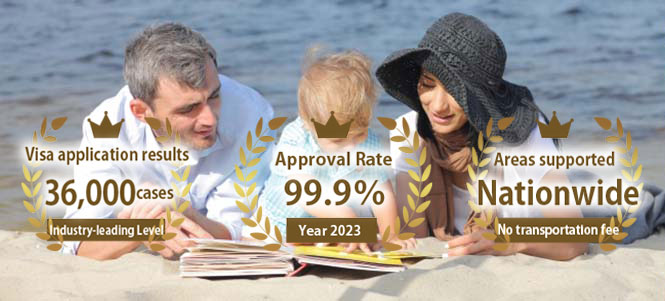
Learn More99.9% Approval Rate (2024)
We decline applications when approval prospects are extremely low — honesty first.
Learn MoreTraining + Compliance (ISO27001)
Quality and information security are systemized for long-term client trust.
Learn MoreFree Consultation to Assess Possibility & Challenges
We clarify approval prospects, risks, and preparation priorities.
Learn MoreFlat Nationwide Pricing — Fully Transparent
Same standards anywhere in Japan. No hidden charges or mid-process fee increases.
Learn More▼Learn more about the 9 reasons ACROSEED is chosen
View ACROSEED’s Track Record
View Client Testimonials & Approved Case Studies
4. Ratings on Google Reviews
ACROSEED Immigration Lawyer's Office has received high evaluations for service quality from many clients, regardless of visa type or nationality.
5. Family Dependent Visa Service Fees (Tax Excluded)
・There are absolutely no additional charges based on your personal circumstances.
・Our services are available nationwide in Japan. Clients outside our area can also use our services at the fees below.
・Payment by Visa or MasterCard is also accepted.

| Invitation from Overseas (Certificate of Eligibility Application) |
JPY 150,000 |
|---|---|
| Change of Status to Family Dependent Visa | JPY 150,000 |
| Family Dependent Visa Renewal | JPY 50,000 |

ACROSEED Immigration Lawyer's Office
Representative Administrative Scrivener
Makoto Sano
1998 Graduated from Aoyamagakuin University
2001 Registered as an administrative scrivener
He has Over 20 years of experience as an international administrative scrivener, specializing in foreign employment consulting and residence procedures for foreign residents in Japan.
Click here to see information about his business achievements
Click here to see books he has authored
Since opening our practice in 1986, we have been involved in consulting on visa applications for foreigners for nearly 40 years as an immigration lawyer.
Telephone consultation, email consultation, online consultation, and consultation at our office are available.