Guide to Changing from Student Visa to Work Visa (For April 2026 Employment)
Last Updated:
Foreign students who wish to work in Japan after graduating from a university or vocational school must change their status of residence from “Student” to a “Work-related Visa”.
The key factor considered by the Immigration Services Agency is the relevance between the field of study (major) and the job duties at the hiring company.
This page explains in detail the types of work visas, procedures, and eligibility by educational institution for those planning to change from a student visa to a work visa in Japan.
- Educational Institutions Eligible for Student-to-Work Visa Change
- Visa Change Patterns by Institution Type
- Main Types of Work Visas and How to Choose
- Schedule, Required Documents, and Screening Time
- Q&A on Changing from Student Visa to Work Visa
- Google Customer Reviews
- Why Choose ACROSEED
- Service Fees for Student-to-Work Visa Application
- Related Pages Frequently Read Together
This page is a guide for individual international students seeking a work visa. For corporate clients, please refer to the page below:

2025 Guide to Hiring New Graduate Foreign Nationals
Services for companies to obtain Work Visas for foreign employees: Engineer/Humanities/International Services, Highly Skilled Professional, Designated Activities (No.46), Specified Skilled Worker, etc.
1. Educational Institutions Eligible for Work Visa Change
When changing your status of residence from a Student Visa to a Work Visa in Japan, the most important factor is which educational institution you graduated from. Under Japan’s Immigration Control Act, applicants must have “completed an educational program that provides the specialized knowledge and skills required for employment.” Therefore, eligibility and screening difficulty for a work visa depend largely on the type of school you completed.
The table below summarizes whether a work visa change is possible by institution type—university, graduate school, vocational school, or Japanese language school—and shows the main types of work visas available. For example, university or graduate school graduates can typically apply for Engineer / Specialist in Humanities / International Services or Highly Skilled Professional visas, while vocational school graduates must hold a “Senmonshi” or “Kōdo Senmonshi” qualification.
| Institution Type | Eligible for Work Visa Change | Main Work Visa Options | Notes |
|---|---|---|---|
| University / Graduate School | ✅ Yes | Engineer / Specialist in Humanities / International Services, Highly Skilled Professional | Most common path. Relevance between major and job is essential (e.g., Business → Sales, IT → Engineer). |
| Junior College | ✅ Yes | Engineer / Specialist in Humanities / International Services (depending on duties) | Possible if the major relates to the job. Less specialized fields face stricter review. |
| College of Technology | ✅ Yes | Engineer / Specialist in Humanities / International Services (mainly technical) | Strong advantage for engineering or technical roles. |
| Vocational School (Specialized Course) | ✅ Possible (under conditions) | Engineer / Specialist in Humanities / International Services, Designated Activities (No.46), Specified Skilled Worker | MEXT-approved specialized course with Senmonshi / Kōdo Senmonshi title required. Consider No.46 for unrelated jobs. |
| Japanese Language School | ❌ Not eligible (for further study only) | — | Language programs alone are not sufficient. Must continue to higher education before employment. |
| High School | ❌ Not eligible (some exceptions) | Specified Skilled Worker (or Designated Activities in limited cases) | Eligible under limited fields (manufacturing, hospitality, caregiving, etc.). |
| Junior High / Miscellaneous School | ❌ Not eligible | — | General or language courses are not applicable for work visas. |
Tell us your major and the type of job/company you plan to join. We will assess whether you can obtain a Work Visa in Japan. (We do not offer job placement services.)
English / Chinese support available.
Contact Us by Email 03-6905-6371
2. Changing from Student Visa to Work Visa by Institution Type
This section explains, based on real-life cases, how to change from a Student Visa to a Work Visa depending on your school type. Immigration authorities focus on the relationship between what you studied and the work you will do.
Even among “international students,” the eligible visa types and required documents differ greatly between universities, vocational schools, and Japanese language schools. Below, we explain the six major education types and key points for each.
1. University / Graduate School Graduates
The most common path for university or graduate school graduates is the Engineer / Specialist in Humanities / International Services Visa. It’s essential that your academic field (e.g., Business, Economics, Law, Languages, IT, Engineering) matches your job duties (e.g., sales, planning, translation, system development, or design).
STEM graduates typically enter engineering positions, while humanities graduates work in planning, sales, or international business. If your income or credentials are high, you may also qualify for the Highly Skilled Professional Visa, which shortens the time required for Permanent Residency.
- Humanities: Business / Economics / Law / Languages → Sales, Planning, Translation, Trade
- STEM: IT → System Engineer / Data Analyst, Mechanical / Electrical → Design, Quality Control
- Those meeting the HSP point criteria may fast-track PR.
2. Junior College / College of Technology
Graduates of junior colleges or colleges of technology may also qualify for a work visa if their field of study closely relates to their job duties.
- Junior college graduates must clearly explain how their studies apply to their job.
- Technical college graduates are well-suited for engineering or production roles.
3. Vocational Schools (Specialized Courses)
Students who completed MEXT-accredited specialized courses and obtained a Senmonshi or Kōdo Senmonshi title may apply for a work visa, provided their field of study matches their job duties.
- Check whether your qualification is “Senmonshi” or “Kōdo Senmonshi.”
- If unrelated to your job, consider Designated Activities (No.46) or Specified Skilled Worker.
4. Japanese Language School Graduates
Completing only a Japanese language program does not meet the academic requirement for a work visa. The typical path is language school → higher education → employment.
- Language courses alone are insufficient for a work visa.
- After advancing to higher education, align your major with your job for visa eligibility.
5. High School Graduates
High school graduates are generally not eligible for standard work visas but may qualify under the Specified Skilled Worker (SSW) system in specific industries.
- Must pass industry and Japanese language exams and work for an approved employer.
- Consider future career paths such as SSW → further study → other visa types.
6. Graduate Research Students (Non-Degree)
Even as a research student, if you have a job offer and expect to receive a degree (Master’s or Doctorate), you can apply for a work visa. Provide documentation showing the link between your research and the job (e.g., job description, research summary).
- Visa change possible with job offer and proof of degree completion.
- Prepare job description and academic certificates carefully.
3. Main Types of Work Visas in Japan & How to Choose
1. Highly Skilled Professional (HSP)
The Highly Skilled Professional is a preferential Work Visa category based on a points system, where education, annual income, and professional experience are scored. Applicants who reach a certain threshold (70 points or more) can be certified.
It targets foreign professionals in highly specialized roles—such as research, engineering, and management—and offers more favorable conditions than standard Work Visas, including relaxed stay limits and Permanent Residency requirements.
In particular, those who have completed a Master’s or Doctoral program and work in research, development, or management can benefit from a shortened period to apply for Permanent Residency (1 year or 3 years) with this visa.
- Typical roles: Researcher, Engineer, University Faculty, Corporate R&D, International Project Manager, Business Executive, etc.
- Main point items: Academic degree (Master’s/PhD), annual income, work experience, research achievements, Japanese proficiency, company size, etc.
- Key features: PR fast-track, work permission for spouse, and eligibility to bring parents under certain conditions.
For changing from a Student Visa to an HSP Work Visa, see the page below.

Change from Student Visa to Highly Skilled Professional (for Students)
Administrative scriveners explain in detail how international students can change to the “Highly Skilled Professional (Highly Talented)” visa, with an automatic HSP points calculator included.
2. Engineer / Specialist in Humanities / International Services
This is the most common Work Visa used by international students who change from a Student Visa. Your field of study at university/graduate school or vocational school (Senmonshi) must be “related” to the duties of your job. It mainly covers white-collar roles in companies and is widely used across administrative, sales, technical, and international business fields.
Examples include: a business major working in sales or corporate planning; an information engineering major working as a system engineer; or a language major working in translation or overseas sales.
The employer can be either a Japanese or foreign-affiliated company; however, the company must demonstrate business stability and the necessity of the position.
- Typical roles: Sales, Back-office, Accounting, HR, System Engineer (SE), Programmer, Interpreter/Translator, Trade operations, Marketing, Designer, etc.
- Application tips: Clearly explain the link between your academic background and job duties, and show consistency with the employer’s business activities.
For details on the Engineer/Specialist in Humanities/International Services visa and how to change from a Student Visa, see the page below.

Change from Student Visa to Engineer/Humanities/International Services (for Students)
Experts explain how international students can change their status: steps, required documents, when to obtain graduation certificates, screening timelines, and how to respond to refusals.
3. Designated Activities (No. 46)
Designated Activities No.46 is a Work Visa option primarily for vocational school graduates when the link between their major and job duties is weak. It targets those who completed a MEXT-approved specialized course and hold the title of “Senmonshi.”
For example, a graduate in tourism business or general business studies working in general administration, sales, customer service, or PR.
Even for roles not easily covered by the Engineer/Humanities/International Services category, a status change may be possible if certain conditions are met.
- Typical roles: Retail staff, Receptionist, Customer support, Office clerk, Hotel front desk, Service industry positions, etc.
- Notes: Full-time employment (regular employee) and work duties that utilize what you learned in your specialized course are required.
For details on Designated Activities No.46, see the page below.

Change from Student Visa to Designated Activities No.46 (for Students)
[For students] Specialists explain status change to “Designated Activities No.46” for on-the-job training and practical experience after graduation and before full-time employment.
4. Specified Skilled Worker (SSW)
Specified Skilled Worker is a status of residence created to address labor shortages in 12 designated industries. It targets foreign nationals who pass skills tests and Japanese language exams, and it can be applied for regardless of academic background (e.g., high school or vocational school graduates).
Employers must be properly registered as accepting organizations and provide fair labor conditions and support systems for daily life.
With certain experience and skills, you may later move to SSW (ii) or change to other Work Visas.
- Industries covered: Nursing care, Food service, Hospitality, Manufacturing, Construction, Agriculture, Fisheries, Building cleaning, Automobile maintenance, Shipbuilding/Marine, Forging/Casting, Industrial machinery, Electrical/Electronic information industries, etc.
- Typical roles: Care worker, Kitchen assistant, Manufacturing line worker, Hotel staff, Mechanic, Construction worker, etc.
- Application tips: Pass the industry skills exam and Japanese test (around JLPT N4 or above) and ensure your employer is contracted with a Registered Support Organization where required.
Tell us your intended industry and job role, and your major. We will advise whether you can obtain a Work Visa in Japan. (We do not provide job placement.)
English / Chinese support available Contact us by email 03-6905-6371
4. Process, Required Documents, and Screening Time for Work Visa Change
1. Timeline for Changing from Student Visa to Work Visa
In general, a status change can be filed with immigration from three months before your current status expires. For international students starting work in April, applications for a Work Visa change are accepted from December 1.
Immigration offices are extremely crowded during this period and reviews often take longer than usual. To secure your Work Visa before your April start date, we recommend applying within December.
The flow below shows how students graduating from university or vocational school can apply from December and obtain approval before April entry.
-
1
- Free Consultation (Early Nov – Early Dec)
- Confirm the link between your job duties at the company offering you a position and your academic background/major.
Our administrative scrivener will assess which status fits and how likely approval is—free of charge.
Consultations available by (1) phone, (2) email, (3) online (Zoom/LINE/WeChat), or (4) in person.
*At this stage, check your expected graduation date and current status expiry to plan the filing schedule.
-
2
- Engagement & Preparation (Early–Mid Dec)
- If you request our support, after signing the agreement and payment, we officially start the procedure.
We coordinate with the employer and collect necessary documents such as the employment contract and company profile.
*Confirm when you can obtain a “Certificate of Expected Graduation” and transcript, and back-plan your application timing.
-
3
- Prepare Application Documents (Mid–Late Dec)
- Based on our track record, ACROSEED prepares documents in the format most likely to be approved.
You will review the prepared forms and statement of reasons and provide signatures as needed.
*At this stage you can apply with a “Certificate of Expected Graduation,” but you may be required to submit the original “Certificate of Graduation” after the ceremony.
Immigration may hold issuance until graduation is confirmed, so obtain the certificate promptly and prepare to submit it quickly.
-
4
- Filing at Immigration (Late Dec – Jan)
- Our administrative scrivener submits the Application for Change of Status of Residence on your behalf.
The screening period is typically about 1–2 months. If it overlaps New Year holidays, it may take slightly longer.
*You may file with a certificate of expected graduation and be asked to add the original “Certificate of Graduation” in Feb–Mar.
Filing early lets you receive results with time to spare before April employment starts.
-
5
- Screening & Approval (Feb – Mar)
- When screening completes, ACROSEED receives the Approval Notice.
Approvals are most often issued from mid- to late March.
If your graduation certificate has not been submitted, immigration may request it at this point.
We submit the certificate on your behalf, complete the visa stickering, and finish the procedure.
If not approved, we will analyze the result and support a re-application.
-
6
- Passport Return & Onboarding (Late Mar – Apr)
- We return your passport with the visa sticker and your residence card. Your work eligibility is now granted, and you can start work from April 1.
*Because final approval may be issued after presenting the original graduation certificate, obtain it right after the ceremony (late Mar) and submit it promptly.
Employers also need time for social insurance enrollment and employment paperwork; prepare with enough buffer.
🕐 Early Nov – Early Dec: Consultation & Engagement
🕐 Mid Dec – Jan: Document preparation & Filing
🕐 Feb – Mar: Screening & Approval
🕐 Apr 1: Employment starts
2. Required Documents
If you entrust us with your case, we will prepare the optimal set of documents based on the lists published by the Immigration Services Agency, tailored to your situation to ensure the smoothest possible review.
1) Status: Engineer / Specialist in Humanities / International Services
2) Status: Highly Skilled Professional
3) Status: Designated Activities (No.46)
4) Status: Specified Skilled Worker
3. Screening Period at the Immigration Services Agency
The screening period is announced monthly. Check the latest average processing time below.
5. Frequently Asked Questions (FAQ)
When international students in Japan apply to change from a Student Visa to a Work Visa, immigration reviews the following points comprehensively.
In particular, the relevance between your major and job duties, the stability of the hiring company, and the fairness of employment conditions are emphasized.
Main screening perspectives include:
- Whether the applicant has the knowledge/skills necessary to perform the job
- Whether the planned job duties correspond to a status of residence under the Immigration Act (e.g., Engineer / Specialist in Humanities / International Services)
- Whether the employer’s business continuity and stability can be recognized
- Whether the employment conditions (salary/benefits) are equivalent to those of Japanese employees
- Whether the applicant is free from grounds for denial of landing (e.g., criminal record, overstay)
These factors are reviewed in total to determine whether a change from “Student” to “Work” status is approved.
Recently, more people work at Japanese companies via staffing agencies. Many students worry that “dispatch employment cannot get a Work Visa,” but in fact it is possible if the correct conditions are met.
The key is whether both the staffing agency and the applicant correctly understand how the status of residence works.
1. The dispatching company (employer) must be licensed for “General Worker Dispatching Business” or “Specified Worker Dispatching Business.”
2. The client company, dispatch period, and job duties are clearly defined, and you are employed as a full-time (regular) employee — not as a part-time worker.
In short, if it is clear which company you will work for, what job you will do, and for how long, and a stable employment relationship is established, obtaining a Work Visa via dispatch is certainly possible.
Even if your application is denied, you will not be asked to leave Japan immediately.
First, check the “Notice of Denial” and identify the reason. Common reasons include insufficient linkage between academics and duties, employer stability issues, or deficiencies in submitted documents.
Many cases can be approved by correcting and supplementing the contents and re-applying. If you are unsure, consult a professional (e.g., administrative scrivener) to plan your re-application strategy.
[For April employment]
International students graduating in March from university/vocational school and starting work on April 1 can apply to immigration from December 1.
Typically, you prepare the offer letter, employment contract, certificate of expected graduation, and transcript, and apply between December and January.
However, immigration may withhold approval until graduation is confirmed, so in many cases final approval is issued after submitting the original “Certificate of Graduation” in mid–late March.
Most approvals are issued in mid–late March, coordinated to meet an April 1 start.
[For employment starting at other times]
For non-April intakes (e.g., autumn entry or rolling hiring), you can apply once your expected graduation is fixed. If graduation is in September, start preparations 1–2 months before graduation.
In such cases, you may apply with a certificate of expected graduation and be asked to submit the original “Certificate of Graduation” afterward.
If your current status expires shortly after graduation, consult and apply at least one month in advance. If you do not plan to continue your studies, be careful not to overstay—apply for a status change promptly after graduation.
Yes, it is possible. However, the HSP visa uses a points system based on factors such as education, annual income, work experience, and research achievements, and you must score at least 70 points.
Students completing Master’s/Doctoral programs who meet income and research criteria may change directly to categories such as Highly Skilled Professional (i) (b) etc.
With this visa, you can enjoy preferential measures such as a shortened period to apply for Permanent Residency (1 or 3 years).
Tell us your intended industry and job role, and your major. We will advise whether you can obtain a Work Visa in Japan. (We do not provide job placement.)
English/Chinese support available Contact us by email 03-6905-6371
6.Google Customer Reviews
7. Why choose ACROSEED
- Why clients choose ACROSEED
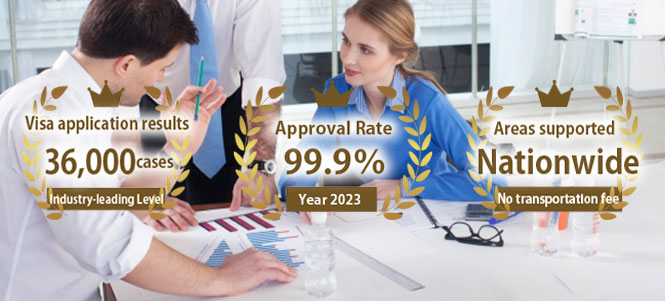
- Founded in 1986; industry-leading 40,000+ visa filings
- 99.9% approval rate; trusted by many clients
- No travel expenses; flat fees nationwide
- Extensive track record in complex/re-application after refusal cases
- No add-on fees; transparent pricing
- Free re-application until approval if refused
- Support available in Japanese, English, and Chinese
Founded in 1986, with 40,000+ visa applications

ACROSEED was founded in 1986. Since 1990—the first year administrative scriveners were allowed to handle immigration under the law—we have specialized in immigration work. Our total filings exceed 40,000 (as of March 2025).
We currently handle 3,000–4,000 visa filings annually, visiting immigration twice a week to stay current on examinations and legal changes.
By choosing ACROSEED, you get services based on the latest examination trends and the industry’s deepest practical experience.
99.9% approval rate—peace of mind backed by clients’ trust
Since opening in 1986, ACROSEED has always prioritized trustworthy services. At the free consultation stage, if approval seems unlikely, we explain this and decline the engagement.
As a result, we have maintained an approval rate of 99%+ (including re-applications) since opening.
However, for cases with a viable chance where clients wish to proceed, we will make a maximum effort together.
Our attentive, tailored service has earned broad support from clients.
No travel fees—flat rates nationwide

Our office is in Nagatacho, Chiyoda-ku, Tokyo, but we handle immigration cases nationwide at flat rates with no travel expenses.
For distant clients, we offer online consultations via Skype or Zoom so you can speak face-to-face with your consultant just like an in-person visit.
Strong results in difficult and re-application cases
We have many approvals for cases repeatedly refused by clients on their own or by other law firms.
ACROSEED’s track record is unparalleled, and we are often referred the most difficult cases from around the country—operating like a “general hospital” for the industry.
Don’t give up—consult us even for seemingly difficult cases.
No add-on fees—transparent pricing

Our service fees are only those listed on our website.
We do not add fees due to client circumstances such as frequent travel or prior refusals.
We provide a transparent pricing system for your peace of mind.
Free re-application until approval if refused

If a case filed by ACROSEED is unfortunately refused, we will re-apply free of charge as long as there remains a possibility of approval.
While some competitors offer “full refunds if refused,” we believe refunds do not solve the client’s problem
.
Accepting a case casually and leaving a refusal record in your filing history can make approval much harder later.
Clients who choose ACROSEED from among many firms deserve our stance of “getting the fastest approval possible—and if refused, supporting relentlessly until approval.”
8. ACROSEED Fees for Work Visa Applications (tax excluded)
• There are no hidden or conditional surcharges based on your profile.
• ACROSEED serves clients nationwide. Clients in distant regions can use the same pricing below.
• Payment by Visa or MasterCard is accepted.

| [Special Price for Students] Change from Student Visa to Work Visa |
¥80,000 |
|---|---|
| [Re-application after Denial] Change from Student Visa to Work Visa |
¥150,000 |
For corporate clients, please see the page below.
2025 Guide to Hiring New Graduate Foreign Nationals
Services for companies to obtain Work Visas for foreign employees: Engineer/Humanities/International Services, Highly Skilled Professional, Designated Activities (No.46), Specified Skilled Worker, etc.
9. Related Pages Often Viewed Together with “Change from Student Visa to Engineer / Humanities / International Services”
For Students
[For Students] Guide to Changing from Student Visa to Work Visa (2025 Edition)
[For Students] Guide to Changing from Student Visa to Engineer / Humanities / International Services (2025 Edition)
[For Students] Guide to Changing from Student Visa to Highly Skilled Professional (2025 Edition)
[For Students] Guide to Changing from Student Visa to Designated Activities (No.46) (2025 Edition)
For HR Managers / Employers
[For HR Managers] Visa and Procedure Guide for Hiring International Graduates (April 2026 Entry)
[For HR Managers] Guide to Obtaining the Engineer / Specialist in Humanities / International Services Visa
[For HR Managers] Applying for the “Highly Skilled Professional” Visa for Foreign Employees
[For HR Managers] Application for “Designated Activities (Notice No.46)” Visa

Administrative Scrivener Corporation ACROSEED
Managing Partner: Makoto Sano
Japan Federation of Administrative Scriveners Associations (Reg. No. 01080685)
Tokyo Administrative Scriveners Association (Member No. 4568)
Founded in 1986
Now in our 39th year specializing in foreign nationals’ legal affairs across two generations.
Registered Administrative Scrivener in 2001
23 years as an international administrative scrivener.
Appointed to the Tokyo Association’s International Division in 2023
Contributing to the development and training of administrative scriveners.
[Track record]
ACROSEED’s legal services are chosen by over 1,000 corporations including listed/global companies. We also have many engagements as lecturers/authors on foreign employment.
Since opening our practice in 1986, we have been involved in consulting on visa applications for foreigners for nearly 40 years as an immigration lawyer.
Telephone consultation, email consultation, online consultation, and consultation at our office are available.