Spouse Visa Renewal Guide: How to Obtain a 3-Year Residence Period (2025)
Last updated:
Guide to Spouse Visa Renewal in Japan
- Application Timing: From 3 months before the expiration date until the last day (early filing recommended during busy periods).
- Possible Residence Periods: 6 months / 1 year / 3 years / 5 years, based on cohabitation, tax records, social insurance, and legal notifications.
- How to Obtain 3 or 5 Years: Continuous cohabitation, accurate tax payment certificates, proof of pension/insurance payments, and completion of legal notifications.
- Avoiding Refusal: Prevent inconsistencies, and submit explanatory letters + evidence for separation periods or unemployment.
- Processing Time: Updated monthly. Check the latest estimate here.
This page is for those who are renewing a Spouse of Japanese / Permanent Resident Visa. For first-time applicants, please see below:
Spouse Visa Application Guide (Marriage)
Requirements, work permission, renewal to permanent residency, separation cases, and required documents are explained by ACROSEED Immigration Lawyer's Office.
1. Requirements for Spouse of Japanese / Permanent Resident Visa Renewal

The renewal of a Spouse of Japanese / Permanent Resident Visa can be submitted from three months before the expiration date at the Immigration Office that has jurisdiction over your registered address.
The average screening period for visa renewal is approximately 2 weeks to 1 month. The renewed residence period will be either 6 months, 1 year, 3 years, or 5 years.
The immigration authority’s criteria for determining the residence period for “Spouse or Child of Japanese National” are generally as follows:
1. Requirements for Obtaining a 5-Year Residence Period
Applicants who meet all of the following conditions:
① Fulfillment of reporting obligations under the Immigration Control Act (address notification, change of residence, change of affiliation, etc.)
② Fulfillment of public obligations such as taxes and social insurance payments
③ If the applicant has a school-age child, the child must be enrolled in elementary or junior high school (including international schools)
④ The primary household supporter fulfills tax payment obligations
⑤ Based on family structure and marriage history, the continuation of marriage and stability of life as a spouse is expected (in principle, more than 3 years of cohabitation after marriage)
2. Requirements for Obtaining a 3-Year Residence Period
Applicants who meet one or more of the following:
① Previously granted 5 years, but at renewal do not meet one or more of the 5-year conditions listed above:
a. Does not meet one or more of the conditions from ① to ④ under the 5-year category
b. Stable continuation of marriage and life as a spouse is still expected based on overall circumstances
② Does not fall under the conditions for 5 years, 1 year, or 6 months and is evaluated as mid-level stability
3. Requirements for Obtaining a 1-Year Residence Period
Applicants who meet one or more of the following:
① Previously granted 3 years, but currently do not meet one or more of the requirements for 5 years
② Marriage circumstances require confirmation of continuity once per year
③ Immigration authority determines the applicant’s status requires annual review
④ Intended stay exceeds 6 months but is within 1 year
4. Requirements for Obtaining a 6-Month Residence Period
Applicants who meet one or more of the following:
① Divorce mediation or divorce litigation is in progress (excluding cases where both parties have no intention to maintain the marriage)
② One spouse clearly intends to divorce
③ Planned stay does not exceed 6 months
5. Comparison of Requirements by Residence Period
| Residence Period | Evaluation Standards | Notes |
|---|---|---|
| 5 Years | Stable cohabitation, fulfillment of legal obligations, and high continuity of marriage | School attendance may be reviewed if a school-age child is present |
| 3 Years | Generally good evaluation but with some conditions requiring confirmation | May be issued when 5 years is not granted due to minor concerns |
| 1 Year | Separation or unemployment requires annual verification | Explanatory letters and supporting documents may help increase the residence period in future renewals |
| 6 Months | Special circumstances such as divorce mediation | Short-term review required |
2. Common Refusal Cases in Spouse of Japanese / Permanent Resident Visa Renewal

Submitting only the required documents listed on the Immigration Services Agency website does not guarantee approval of your application.
As a general rule in immigration procedures, the burden of proof lies with the applicant.
Therefore, if there are any weak points regarding the renewal requirements, you must proactively explain them and submit additional supporting documents.
For spouse visa renewal, one of the most important points is that you must never provide false information, even if your situation may be disadvantageous in the screening process.
Many refusal cases in renewal applications are the result of false declarations. For example, falsely claiming that you are living together when in fact you are not is a clear reason for refusal.
In the worst case, reporting a false address to the Commissioner of the Immigration Services Agency may constitute grounds for cancellation of your residence status.
Below are some typical patterns where a spouse of Japanese / permanent resident visa renewal tends to be refused.
1. Insufficient Explanation of Stable Marital Life
For spouse visa renewal, living together as a married couple is a fundamental requirement. However, in real life, there may be periods when cohabitation is difficult due to work assignments, illness, or caring for parents.
Even when there are legitimate reasons, if you cannot properly explain and prove the situation to the Immigration Office, your renewal application may still be refused.
Similarly, if you happen to be unemployed at the time of renewal due to a recent job change, you need to prove your economic stability and future outlook; failure to do so may also lead to refusal.
2. Failure to Fulfill Public Obligations
For spouse visa applications, payment status of resident tax is an important examination point.
Especially, records of non-payment or late payment can be a factor leading to refusal at renewal, so extra care is required if you are self-employed or have changed jobs during the previous tax year.
As of 2025, payment status of public pension and public health insurance is not strictly examined in spouse visa renewal. However, for permanent residence applications, if there are arrears or delays in the last two years, the application is likely to be refused. If you are considering applying for permanent residence from a spouse status, please also pay attention to pension and health insurance contributions.
Click here for a self-check of the requirements when applying for permanent residence from a spouse of Japanese status:

Self-check: Permanent Residence Requirements from “Spouse of Japanese National”
Simply answer Yes/No. The system automatically shows the result and a guidance sheet on how to address any missing points (print/PDF available).
3. Failure to Fulfill Notification Obligations under the Immigration Control Act
In addition to the address notification obligations on the residence card, holders of spouse visas also have notification obligations regarding their marital status. In the event of divorce or death of the Japanese spouse, you must notify the Immigration Office within 14 days.
These notification obligations are not widely known, and there are cases where people fail to report simply because they were unaware of the system. This can later cause disadvantages at the time of renewal or permanent residence application, so please be careful.
3. Required Documents for Spouse of Japanese / Permanent Resident Visa Renewal

The list of required documents is frequently revised due to changes in laws and regulations. Please always check the latest information on the Immigration Services Agency’s official website.
If you entrust your case to us, we will use the required documents listed on the Immigration website as a base and prepare a document set tailored to your situation that is designed to maximize the chance of approval.
1. Required Documents When Applying for “Spouse or Child of Japanese National” (Renewal of Period of Stay)
(Immigration Services Agency website)
1. Application for Extension of Period of Stay 1 copy
2. Photograph 1 copy
3. Family register (koseki tohon – full certificate) of the Japanese spouse 1 copy
4. Documents proving the ability to cover living expenses in Japan
(1) The supporter of the applicant’s living expenses must submit the latest one year’s resident tax taxation (or non-taxation) certificate and tax payment certificate (showing the total annual income and tax payment status) 1 copy each
(2) If the above (1) documents are not sufficient to prove financial capability, submit one or more of the following:
a. Copies of bankbook or savings account records as appropriate
b. Certificate of expected employment or job offer letter issued by a Japanese company as appropriate
c. Other equivalent documents as appropriate
5. Letter of guarantee from the Japanese spouse 1 copy
6. Copy of resident record (juminhyo) listing all household members including the Japanese spouse 1 copy
7. Passport to be presented
8. Residence card to be presented
2. Checklist of Required Documents for Spouse Visa Renewal
- Resident tax taxation (or non-taxation) certificate + tax payment certificate (latest 1 year, with income amounts clearly shown)
- Documents showing payment status of pension and health insurance (to prepare for future permanent residence application)
- Documents proving actual cohabitation (resident record of all household members, utility bills, postal items, etc.)
- Explanatory letter and supporting documents for periods of separation, unemployment, or recent job changes
- Confirmation that notification obligations (address, marital status, etc.) have been fulfilled within the legal deadline
* Required documents may vary depending on each case. We will design a document set with the highest possible approval rate based on your individual situation.
4. Flow and Processing Time for Spouse of Japanese / Permanent Resident Visa Renewal
1. Flow of Spouse Visa Renewal (Japanese Spouse / Permanent Resident)
-
1
- Free Consultation
-
First, we confirm your current residence status and marital situation, and carefully assess whether you can obtain a 3-year or 5-year visa at the next renewal, and whether there is any risk of refusal.
In particular, we review key points in the examination such as tax payment status, pension and health insurance enrollment, periods of separation, and job changes, and propose improvement measures where necessary.
Consultations are available through any of the following:
- ① Telephone consultation (03-6905-6371)
- ② Email consultation (available 24 hours)
- ③ Online consultation (Zoom / LINE / WeChat, etc.)
- ④ Visit to our Tokyo Nagatacho office
You can contact us from anywhere in Japan. The initial consultation is free of charge.
-
2
- Engagement of Our Services
-
Based on the consultation, if you decide to formally request our support, we will start the case once the service agreement is signed and the fee is paid.
We will then provide you with a written explanation of the future schedule, list of required documents, and important points to be aware of in the examination. Your dedicated immigration lawyer will answer any questions you may have in detail.
-
3
- Preparation of Application Documents
-
Our specialists will design the document set that offers the highest possible chance of approval, tailored to your specific circumstances.
To aim for an extension of your residence period (3 years or 5 years), we carefully prepare documents that prove the substance of your marriage, stability of your living base, and fulfillment of public obligations.
After preparation, all documents will be sent to you for review. Once you have confirmed the content and signed where necessary, we complete the preparation for filing.
-
4
- Filing at the Immigration Services Agency
-
As soon as everything is ready, an immigration lawyer of ACROSEED Immigration Lawyer's Office will submit the application on your behalf to the competent Immigration Services Bureau.
Your personal appearance is not required. After submission, we monitor the progress of the examination and handle all inquiries or requests for additional documents from immigration.
As a general guide, the examination period is around 1–2 months, but this may vary depending on the busy season and the details of the case.
-
5
- Receiving the Approval and Visa Seal
-
The approval notice will be sent directly to ACROSEED. Our immigration lawyer will visit the Immigration Office on your behalf to complete the visa seal procedure and have the new period of stay printed on your residence card.
At this point, the renewal is formally completed and the new residence status becomes effective.
-
6
- Returning Your Residence Card and Passport
-
We will return your renewed residence card, passport, and any other entrusted documents to you, thereby completing the procedure.
If the result is a 1-year visa, we will provide feedback on what should be improved for the next renewal, and offer advice on how to aim for a 3-year visa next time.
For those who are interested, we can also provide a free outline of a step-up plan toward permanent residence in the future.
2. Processing Time for Spouse Visa Renewal
The processing time is updated monthly and officially published. You can check the latest average processing days at the link below:
6. Q&A on Spouse of Japanese / Permanent Resident Visa Renewal
- From when can I apply for renewal of my spouse visa?
-
Renewal of a spouse visa can be applied for from 3 months before the expiration date of the current period of stay up to the day of expiry.
You must submit the required documents to the Immigration Services Bureau that has jurisdiction over your place of residence. If your renewal timing overlaps with busy periods such as the fiscal year-end or before long holidays, the examination tends to take longer, so it is recommended to apply 1–2 months in advance.
Even if your current period of stay expires while your application is under examination, you may continue to stay in Japan under the status of “application for extension in process”, but it is necessary to have the “application received” stamp placed on the back of your residence card.
- How can I obtain a 3-year or 5-year period of stay at renewal?
-
To obtain a longer period of stay such as 3 years or 5 years, you need to prove comprehensively that your marital life is stable and that your living base is firmly established in Japan.
In particular, the immigration authority focuses on the following points:
1) Continued cohabitation of the couple (e.g. resident record at the same address, utility bills, etc.)
2) No arrears in resident tax, as shown in taxation and tax payment certificates
3) Proper fulfillment of public obligations such as national pension and health insurance
4) Timely submission of notifications required under the Immigration Control Act (change of address, change of employer, etc.)
Presenting these points in consistent, well-organized documents increases the likelihood that your application will be regarded as reliable and may lead to a longer period of stay.
- Can I renew my spouse visa while living separately from my spouse?
-
Renewal may still be approved during a period of separation if there are legitimate reasons such as work assignment, transfer, medical treatment, or nursing care, and if the substance of the marriage remains intact.
In such cases, it is important to clearly describe the period and reason for the separation, as well as future plans for living together again, in a written explanation (“letter of reason”), and attach supporting documents such as transfer orders, medical records, travel history, and communication records. If the separation is deemed to be due to marital discord or separation in anticipation of divorce, the risk of refusal is high, so it is crucial to objectively demonstrate the intention to maintain the marital relationship.
- What types of cases are more likely to be refused at renewal?
-
Major causes of refusal include:
1) False declarations, such as claiming to live together when in fact you do not
2) Insufficient documents proving the substance of the marital relationship
3) Non-payment or arrears of resident tax
4) Failure to fulfill notification obligations (e.g. divorce, change of address).
In addition, if the couple is already living separately or in divorce mediation at the time of renewal, the case will be examined very carefully. As countermeasures, it is important to submit accurate information, explain any issues in a written statement, and attach objective evidence such as tax certificates and proof of cohabitation to demonstrate that your application is sincere and honest.
- Is renewal possible even if we are currently living apart?
-
If there are legitimate reasons (such as work assignment, transfer, medical treatment, nursing care, or childcare support) and you can prove with documents that the substance of the marriage is continuing, renewal may still be possible.
Organize information such as when the separation began, how long it has lasted, the future prospect of living together again, and the current status of the couple’s communication (plans to move, travel records, remittances, communication history, etc.), and show consistency through a written explanation plus supporting evidence.
- Can I renew my spouse visa if I have had a period of unemployment or just changed jobs?
- It is still possible, depending on the circumstances. You will need to explain the reasons for the period of unemployment or income reduction, as well as your future employment prospects and plan for maintaining your livelihood, supported by evidence such as job offer letters, employment contracts, or bank balance and savings records.
7. Overview of Visa Renewal Support Service for “Spouse of Japanese National, etc.”
1. Service Overview
This service is designed for those who are considering a future permanent residence application and wish to obtain a 3-year period of stay when renewing their “Spouse of Japanese National, etc.” visa.
By preparing and submitting more detailed supporting documents than in a standard renewal, we aim to maximize your approval rate and help you obtain a 3-year spouse visa at renewal.
The service covers the following cases:
We also support cases where this is your first time renewing a spouse visa.
2. Services Included
- Proposal and preparation of the document set designed to achieve the highest possible approval rate
- Filing the application and completing the visa seal procedure at the Immigration Services Bureau on your behalf
- Application for re-entry permit at the same time (upon request)
- Checking the examination progress during the processing period and handling requests for additional documents
- Free re-application in case of initial refusal
- If only 1 year is granted, the next renewal application will be handled free of charge
- If 3 years are granted, special discounted support for your future permanent residence application
3. Why choose ACROSEED
- Why clients choose ACROSEED
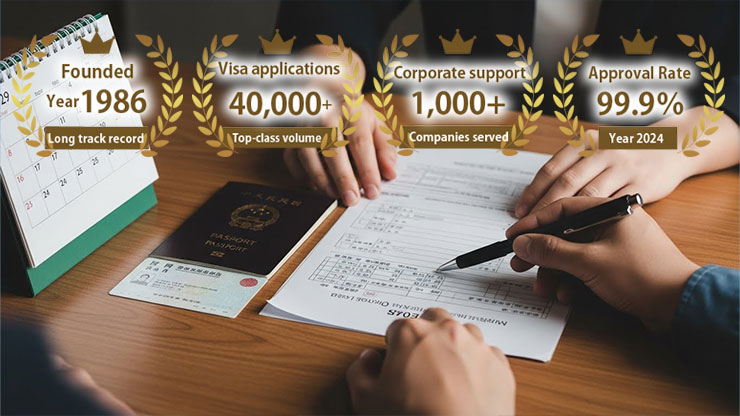
- Founded in 1986; industry-leading 40,000+ visa filings
- 99.9% approval rate; trusted by many clients
- No travel expenses; flat fees nationwide
- Extensive track record in complex/re-application after refusal cases
- No add-on fees; transparent pricing
- Free re-application until approval if refused
- Support available in Japanese, English, and Chinese
Founded in 1986, with 40,000+ visa applications
ACROSEED was founded in 1986. Since 1990—the first year administrative scriveners were allowed to handle immigration under the law—we have specialized in immigration work. Our total filings exceed 40,000 (as of March 2025).
We currently handle 3,000–4,000 visa filings annually, visiting immigration twice a week to stay current on examinations and legal changes.
By choosing ACROSEED, you get services based on the latest examination trends and the industry’s deepest practical experience.
99.9% approval rate—peace of mind backed by clients’ trust
Since opening in 1986, ACROSEED has always prioritized trustworthy services. At the free consultation stage, if approval seems unlikely, we explain this and decline the engagement.
As a result, we have maintained an approval rate of 99%+ (including re-applications) since opening.
However, for cases with a viable chance where clients wish to proceed, we will make a maximum effort together.
Our attentive, tailored service has earned broad support from clients.
No travel fees—flat rates nationwide

Our office is in Nagatacho, Chiyoda-ku, Tokyo, but we handle immigration cases nationwide at flat rates with no travel expenses.
For distant clients, we offer online consultations via Skype or Zoom so you can speak face-to-face with your consultant just like an in-person visit.
Strong results in difficult and re-application cases
We have many approvals for cases repeatedly refused by clients on their own or by other law firms.
ACROSEED’s track record is unparalleled, and we are often referred the most difficult cases from around the country—operating like a “general hospital” for the industry.
Don’t give up—consult us even for seemingly difficult cases.
No add-on fees—transparent pricing

Our service fees are only those listed on our website.
We do not add fees due to client circumstances such as frequent travel or prior refusals.
We provide a transparent pricing system for your peace of mind.
Free re-application until approval if refused

If a case filed by ACROSEED is unfortunately refused, we will re-apply free of charge as long as there remains a possibility of approval.
While some competitors offer “full refunds if refused,” we believe refunds do not solve the client’s problem
.
Accepting a case casually and leaving a refusal record in your filing history can make approval much harder later.
Clients who choose ACROSEED from among many firms deserve our stance of “getting the fastest approval possible—and if refused, supporting relentlessly until approval.”
4. Service Fees for Spouse Visa Renewal Support (Excluding Tax)
If only a 1-year period of stay is granted, we will handle the next renewal application free of charge.
ACROSEED Immigration Lawyer's Office provides nationwide service in Japan. Even if you live far from Tokyo, you can request our support at the same fees shown below.
Payment by VISA and MasterCard is also available.

| Renewal application aiming for a 3-year Spouse of Japanese Visa | 70,000円 |
|---|---|
| Standard renewal application (Spouse of Japanese Visa) |
50,000円 |
| Renewal application for Spouse of Japanese Visa (when there are changes such as remarriage) |
150,000円 |

Administrative Scrivener Corporation ACROSEED
Managing Partner: Makoto Sano
Japan Federation of Administrative Scriveners Associations (Reg. No. 01080685)
Tokyo Administrative Scriveners Association (Member No. 4568)
Founded in 1986
Now in our 39th year specializing in foreign nationals’ legal affairs across two generations.
Registered Administrative Scrivener in 2001
23 years as an international administrative scrivener.
Appointed to the Tokyo Association’s International Division in 2023
Contributing to the development and training of administrative scriveners.
[Track record]
ACROSEED’s legal services are chosen by over 1,000 corporations including listed/global companies. We also have many engagements as lecturers/authors on foreign employment.
Since opening our practice in 1986, we have been involved in consulting on visa applications for foreigners for nearly 40 years as an immigration lawyer.
Telephone consultation, email consultation, online consultation, and consultation at our office are available.