What is the Highly Skilled Professional Visa? Complete Overview and Strategic Use
Last updated:
Highly Skilled Professional Visa Guide
The Highly Skilled Professional (HSP) visa is a system that evaluates applicants based on points assigned to their academic background, professional experience, annual income, and other factors, and grants preferential immigration treatment to individuals who meet certain criteria.
However, since the decision is based on a comprehensive review, it is not determined mechanically by points alone.
This page avoids duplicating detailed explanations already provided on individual pages, such as the specifics of the point system and preferential measures, and instead organizes the information so that you can understand the overall structure of the Highly Skilled Professional visa (which page explains what) at a glance.
- Overview of the Highly Skilled Professional Visa
-
Types and Procedures of the Highly Skilled Professional Visa (Pages You Should Read First)
- Highly Skilled Professional Type 1 (a) Point Calculator
- Highly Skilled Professional Type 1 (b) Point Calculator
- Highly Skilled Professional Type 1 (c) Point Calculator
- Highly Skilled Professional Type 2
- Point System Item List
- Highly Skilled Professional Visa Renewal
- Permanent Residency through Highly Skilled Points
- Highly Skilled Professional Visa Rejection
- Typical Consultation Patterns (Guide by Situation)
- Strategic Use of the Highly Skilled Professional Visa
- Common Misunderstandings (Key Pitfalls)
- ACROSEED Support System
- Frequently Read Pages Related to the Highly Skilled Professional Visa
1. Overview of the Highly Skilled Professional Visa
Unlike general work visas (such as Engineer / Specialist in Humanities / International Services), the Highly Skilled Professional visa evaluates applicants based on a point-based system that considers academic background, professional experience, annual income, research achievements, and other factors, and grants preferential immigration treatment on the premise that the applicant engages in activities as highly skilled personnel.
Meeting a certain threshold (typically 70 points or more) is the starting point, but the decision is not made mechanically based on total points alone.
In actual examinations, immigration authorities verify whether the breakdown of points is reasonable, whether sufficient supporting documentation is provided, and whether the applicant's current job duties are appropriate for Highly Skilled Professional activities.
In addition, factors such as income continuity, the stability and organizational structure of the employer, and compliance with tax and social insurance obligations during residence may also be considered comprehensively.
The Highly Skilled Professional visa is divided into Type 1 (a/b/c) and Type 2, and these categories differ in permitted activities, period of stay, and relationship with future permanent residency.
Therefore, the initial decision regarding which category to apply for can affect future renewals, transitions to permanent residency, and even rejection risks.
While the Highly Skilled Professional visa offers significant advantages once obtained, careful planning is required when circumstances change, such as job changes, income fluctuations, or changes in job duties.
Accordingly, it is important to understand the system and consider the overall structure from perspectives such as:
Which category should you apply under,
How should you plan renewal, transition to Type 2, or permanent residency,
And how should you respond in case of rejection.
We recommend starting from this page and reviewing the pages most relevant to your goals and situation (category pages, point calculation, renewal, permanent residency, rejection response, etc.), and organizing the necessary information step by step.
2. Types and Procedures of the Highly Skilled Professional Visa (Pages You Should Read First)
The Highly Skilled Professional visa is divided into Type 1 (a/b/c) depending on activity content, and transition to Type 2 may be considered if certain requirements are met.
Below is a guide directing you to the relevant pages depending on what you want to know.
・Highly Skilled Professional Type 1 (a) (Example: Advanced Academic Research Activities)
・Highly Skilled Professional Type 1 (b) (Example: Advanced Specialized / Technical Activities)
・Highly Skilled Professional Type 1 (c) (Example: Advanced Business Management Activities)
・Highly Skilled Professional Type 2 (Position and transition considerations)
■ Related Procedures Frequently Considered Together
・Status change procedures required when changing jobs under Highly Skilled Professional Type 1 (b)
・Highly Skilled Professional Visa Renewal (Key points and considerations)
・Permanent Residency through Highly Skilled Points (Overview of points-based permanent residency)
・Highly Skilled Professional Visa Rejection and Reapplication (Response after rejection)
■ Point System and Preferential Measures (Details)
・Point System Explanation (Calculation methods and additional point items)
・Preferential Measures for Highly Skilled Professionals (Spouse work permission, accelerated permanent residency, etc.)
*Detailed explanations are provided on the linked pages. This overview page focuses on presenting the overall structure while avoiding duplication.
3. Common Consultation Patterns on the Highly Skilled Professional Visa (Situation-Based Guide)
Consultations regarding the Highly Skilled Professional Visa tend to increase not only at the “pre-application stage,”
but also when a person’s residence situation changes—such as changing jobs, renewal, applying for permanent residency,
or redesigning a strategy after a rejection.
While the system itself is organized around a points framework,
in practice the key issues differ depending on individual circumstances,
so it is important to organize the discussion according to your situation.
Here, we summarize frequently asked consultations by “situation.” Please start by checking the item that is closest to your own case.
3-1. I don’t know which category (a/b/c) I should apply under
The Highly Skilled Professional Visa is divided into Type 1 (a/b/c) depending on the nature of the activities,
and the way you organize your job description and the points you should emphasize will vary depending on which category you choose.
For example, whether your work is primarily research activity, a specialized technical role,
or falls under business management will change the axis of evaluation,
making the initial category selection an important step.
Start by objectively organizing your actual duties and confirming which category your work most closely aligns with.
- Type 1 (a) Point Auto-Calculation Tool / Type 1 (b) Point Auto-Calculation Tool / Type 1 (c) Point Auto-Calculation Tool
3-2. I’m worried I may not have enough points / I’m not confident in my calculation
Although the point system is numerical, there are many areas where applicants hesitate,
such as “which achievements qualify for additional points” or “to what extent projected annual income will be evaluated.”
Beyond the total score,
it is crucial to determine how you will present supporting evidence for each additional point item.
By carefully confirming the details—such as how academic background is evaluated, how years of work experience are proven,
and the standards used to calculate annual income—you can reduce risk.
3-3. I plan to change jobs / my annual income will fluctuate
If you are changing jobs, transferring departments, or changing job duties,
immigration may review not only whether your points are maintained,
but also the consistency of your specialization and the stability of your employment.
Also, if your income decreases, or if bonuses and incentives account for a large proportion,
it becomes important which figures will be used as the basis for evaluation.
Depending on the timing of the application and how your explanatory materials are prepared, the way your case is viewed in examination may differ. For peace of mind, it is advisable to confirm in advance, including renewal and rejection risks.
3-4. I want to obtain permanent residency quickly (Points-Based Permanent Residency)
The Highly Skilled Professional system includes a mechanism that, if certain conditions are met,
can shorten the required period of residence before applying for permanent residency.
However, in permanent residency examination, stability of residence and tax compliance are also reviewed comprehensively.
Therefore, it is not only about “having high points,” but also about strategic planning regarding
when to apply.
3-5. I was rejected / I want to reapply
When an HSP application is rejected,
the reasons may involve multiple factors—not merely insufficient points—
such as inadequate explanation of job duties or how supporting documents for annual income were evaluated.
For reapplication, it is important to redesign the strategy based on the previous submission,
including “what should be strengthened” and “whether a change to another status of residence should be considered.”
3-6. A company told me they want to hire me under the Highly Skilled Professional category
In recent years, we have also seen an increase in consultations from companies,
such as cases where they wish to hire international students who are expected to graduate from Japanese universities
as Highly Skilled Professionals, or where they wish to recruit highly skilled talent living overseas
under the HSP framework.
In such cases, it is important not only that the applicant meets the points requirements,
but also that the receiving company’s structure and the validity of the job design are appropriate.
Details are explained on our corporate-client page.
4. How to Strategically Utilize the Highly Skilled Professional Visa
The Highly Skilled Professional Visa is not meant to end with “obtaining approval” as the final goal.
Rather, what matters is medium- to long-term residence planning that anticipates
renewal, job changes, transition to Type 2, and permanent residency application.
The system provides clear criteria through the points framework,
but in practice, risks and options may change depending on factors such as
“when you apply,” “which achievements you emphasize,” and
“when you consider category changes or permanent residency.”
For example, if you aim for permanent residency in the future,
the stability of your income level, consistency of job duties, the structure of your affiliated institution,
and your compliance with tax and social insurance obligations during residence
may be examined.
Therefore, what matters is not only single-year conditions,
but also how you can explain “multi-year trends.”
In addition, if you anticipate a job change or promotion, you must consider not only maintaining points, but also how continuity of specialization and the rationality of employment conditions may affect future renewal or transition to Type 2. If you decide based solely on short-term benefits, the consistency of your explanations may later be questioned during procedures.
The optimal route differs depending on your current status of residence, job duties, employment type, family composition, and future career plans. Rather than thinking “it’s fine because there is no problem right now,” organizing the key issues early and designing a plan that looks ahead to future procedures is the key to making the most of the Highly Skilled Professional system.
5. Common Misunderstandings (Pitfalls)
Because the Highly Skilled Professional Visa is point-based, it is often assumed that “as long as the numbers are met, it will be approved.” However, in actual examination, the supporting evidence and consistency with the real situation are emphasized. Below are common misunderstandings.
-
If I have 70 points or more, approval is guaranteed
Points are an important benchmark, but immigration also reviews the reasonableness of the breakdown, the sufficiency of supporting documents, and consistency with your current job duties. -
If my annual income is high, I’m fine
Annual income is an important evaluation factor, but if it is not related to your specialization or the nature of your activities, it may not lead to a favorable evaluation. -
I can automatically transition to Type 2
Transition to Type 2 requires meeting certain residence track-records and conditions; it is not an automatic switch. -
Once approved, I can feel safe afterward
At renewal, immigration may check changes since the last approval (job changes, income fluctuations, job duty changes, etc.). Maintaining ongoing consistency is important.
If you proceed with an application based on these misunderstandings, it may result in unexpected requests for additional documents or increased rejection risk. It is important to understand how the system works and make decisions that align with your actual circumstances.
6. ACROSEED Support System (Highly Skilled Professional Visa – Overview)
1. Service Overview

In this section, for those who feel that “I still feel uncertain no matter which page I read” or “It’s difficult to apply the information to my own case,” we introduce comprehensively the scope of support that ACROSEED Immigration Lawyer's Office can provide regarding the Highly Skilled Professional (HSP) visa.
While the Highly Skilled Professional visa uses a points-based system, examinations may comprehensively review factors such as the reasonableness of the breakdown of points, the actual work situation, evidence supporting annual income, consistency between job duties and academic/professional background, and the structure of the receiving organization. Therefore, it is important not only to meet the score, but also to design the application—“with which documents,” “in what order,” and “to what extent you explain.”
At ACROSEED Immigration Lawyer's Office, we organize the key issues for each stage—Highly Skilled Professional Type 1 (a/b/c) and Type 2, renewal, permanent residency, and responses after rejection—and build a complete set of application documents in a format that is easy for the examiner to assess. What matters is not only “filing on your behalf,” but also proactively eliminating points where risk is likely to arise, including planning your future residence pathway.
We are seeing an increase in consultations in cases such as the following.
・I can calculate the points, but I am concerned about how to submit supporting evidence (income, work history, degrees, etc.)
・I have a job change / departmental transfer / change in job duties, and I am unsure about the application strategy (timing of application)
・My annual income fluctuates (bonuses/incentives account for a large share), so I am concerned about how it will be evaluated
・I want to organize my plan with future transition to Type 2 or permanent residency (points-based PR) in mind
・I was rejected and want to rebuild the strategy, including reapplication and/or change to another status
This overview page organizes the overall framework of the system, but in actual applications, the key issues change depending on individual circumstances (the reality of job duties, contract structure, job-change history, family situation, tax and social insurance status, etc.). Even if you are at the stage of “I don’t know which pages to read or how,” we can support you starting from organizing your situation.
2. What Our Support Includes
- Organizing the application strategy (category selection: Type 1 a/b/c or Type 2, and prioritizing renewal/change/permanent residency, etc.)
- Reconfirming points and designing how to present supporting evidence for additional points (academic background, work history, annual income, etc.)
- Organizing job duties, organizational structure, and employment conditions (creating an “explanatory structure” that is understood in examination)
- Guidance on the full set of required documents, support for collection, and preparing supplemental materials/explanatory statements as needed
- Preparation of the full set of application documents and filing on your behalf (depending on the plan) / responding to additional document requests during examination
- (If necessary) Designing reapplication after rejection, or proposing a strategy to change to another status of residence
3. Advantages of Choosing ACROSEED Immigration Lawyer's Office
With the Highly Skilled Professional visa, even if the points and occupation are the same, how you organize the facts, how you present supporting evidence, and the order of explanation can change how the examiner understands the case. In particular, in cases involving job changes, changes in duties, or income fluctuations, misunderstanding “what the key issues are” can increase the risk of additional document requests and prolonged examinations.
At ACROSEED Immigration Lawyer's Office, we first inventory each applicant’s circumstances and extract key issues that are likely to be reviewed (consistency of specialization, continuity of income, company structure, legality during residence, etc.). Then, to make it easier for the examiner to assess, we arrange materials in the order of Conclusion → Evidence → Supplement, and present a consistent logic explaining “why this application is appropriate.”
In line with the purpose of this overview page, we prepare document consistency not only for “obtaining approval this time,” but also on the premise of mid- to long-term residence planning that anticipates renewal, transition to Type 2, and permanent residency. Designing early can reduce the risk of inconsistencies in explanations in future procedures.
Even if an application is rejected, we do not simply reapply. Based on the reasons for rejection, we organize “what should be strengthened and how,” and if necessary, we compare realistic options including a change to another status, and propose an appropriate strategy.
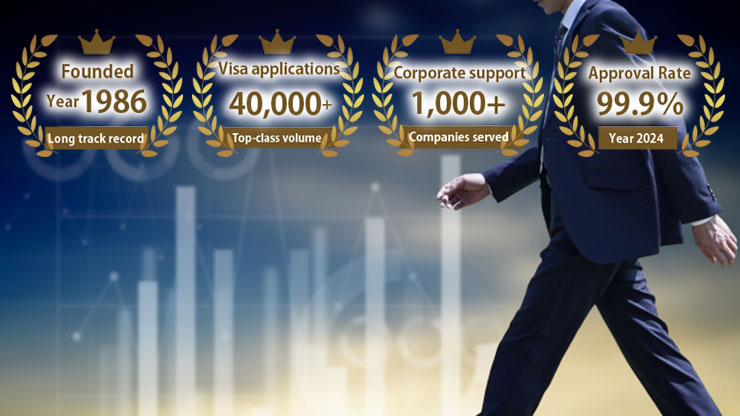
Founded in 1986 — Over 40,000 Visa Cases
We apply long-term screening insight and corporate-level standards to your individual case.
Learn MoreVeteran Immigration Specialists (10+ Years)
Experts who understand screening criteria reduce refusal risks through consulting.
Learn MoreCentralized Headquarters System
No dispersed standards — decisions reflect accumulated experience and current trends.
Learn MoreMultinational Staff Offering Practical Multilingual Support
Not interpreters — but practitioners who understand visa evaluation points in English/Chinese.
Learn MoreOnline Progress Management System
Real-time status, document tracking, and uploads reduce inquiry stress.
Learn More99.9% Approval Rate (2024)
We decline applications when approval prospects are extremely low — honesty first.
Learn MoreTraining + Compliance (ISO27001)
Quality and information security are systemized for long-term client trust.
Learn MoreFree Consultation to Assess Possibility & Challenges
We clarify approval prospects, risks, and preparation priorities.
Learn MoreFlat Nationwide Pricing — Fully Transparent
Same standards anywhere in Japan. No hidden charges or mid-process fee increases.
Learn More▼Learn more about the 9 reasons ACROSEED is chosen
View ACROSEED’s Track Record
View Client Testimonials and Approved Case Studies
4. Ratings and Reviews on Google
ACROSEED has received high evaluations from many clients regarding the quality of our services, regardless of visa type or nationality.
5. Fees for HSP Visa Application Services (Tax Not Included)
・There are absolutely no additional fees based on the client’s conditions.
・ACROSEED Immigration Lawyer's Office provides services nationwide. Clients outside the area may also request our services at the fees listed below.
・Payment by Visa or MasterCard is also available.

| Change from another work visa to Highly Skilled Professional |
JPY 100,000 |
|---|---|
| HSP Visa Renewal (No changes) |
JPY 50,000 |
| HSP Visa Renewal (With changes such as a job change) |
JPY 150,000 |
| Obtaining Permanent Residency from HSP | JPY 100,000 |
| Obtaining Permanent Residency for those who meet HSP points under another work visa | JPY 130,000 |
| Reapplication for HSP Visa after a rejection |
JPY 150,000 |

ACROSEED Immigration Lawyer's Office
Representative Administrative Scrivener
Makoto Sano
1998 Graduated from Aoyamagakuin University
2001 Registered as an administrative scrivener
He has Over 20 years of experience as an international administrative scrivener, specializing in foreign employment consulting and residence procedures for foreign residents in Japan.
Click here to see information about his business achievements
Click here to see books he has authored
Since opening our practice in 1986, we have been involved in consulting on visa applications for foreigners for nearly 40 years as an immigration lawyer.
Telephone consultation, email consultation, online consultation, and consultation at our office are available.