Japan’s Business Manager Visa — 2025 Law Revision Explained
Last updated:

Business Manager Visa Law Revision at a glance (under 30 seconds)
- When: Effective October 16, 2025. Applications already accepted are, in principle, reviewed under the old criteria; transitional measures apply to current holders for up to three years.
- What changes: Capital etc. set at JPY 30 million, at least one full-time employee required, Japanese B2/N2, education or management experience, and expert verification of the business plan, among others.
- Who is affected: New applications immediately; for current holders, renewal reviews will more strictly verify business substance, public dues, and employment structure.
- What to do first: Redesign your funding plan, hire N2-level talent and arrange social insurance, confirm permits/licenses, and have your plan reviewed by qualified experts.
Under the Business Manager Visa Law Revision effective October 16, 2025, the capital requirement for the Business Manager status has been substantially raised from JPY 5 million → JPY 30 million. In addition, requirements such as employing at least one full-time employee, establishing a Japanese-language system at B2 (JLPT N2) level, and expert verification of the business plan are newly introduced.
Furthermore, since July 2025, renewal examinations for the Business Manager visa have also become stricter in practical operation.
This article clearly explains, from an expert perspective, the background to the revision, the impact on entrepreneurs and operating companies, the transitional measures and renewal points, and the practical responses directly linked to approval (funding plan, hiring, and compliance).
- The Former Business Manager Visa (Pre-Revision Overview)
- Business Manager Visa — 2025 Law Revision (Effective Oct 16, 2025): Key Changes & Practical Guidance
- Background: Why the Revision Was Made
- Impact on Foreign Entrepreneurs
- Practical Considerations After the Revision
- Renewing a Business Manager Visa
- FAQ: Business Manager Visa 2025 Law Revision
- Summary of the 2025 Business Manager Visa Law Revision
1. The Former Business Manager Visa (Pre-Revision Overview)
The “Business Manager” status of residence is granted to foreign nationals who establish a company in Japan and conduct business as an owner or manager. The main requirements until now were as follows:
・Securing a place of business (office)
・A business plan that demonstrates continuity and stability
Among these, the JPY 5 million capital threshold was a level that many foreign entrepreneurs could relatively clear, and it supported the entry of startups into Japan.
2. Business Manager Visa — 2025 Law Revision (Effective Oct 16, 2025): Key Changes & Practical Guidance
*The following organizes the intent of the ministerial/ordinance revisions in an easy-to-understand manner. Actual practice may vary depending on instructions at the application counter and examination precedents. Please consult for individual determinations.
1. Major Requirement Changes
・At least one full-time employee is mandatory at the company, etc. Eligible persons are Japanese nationals, Special Permanent Residents, and those with statuses listed in Appended Table II (Permanent Resident / Spouse or Child of Japanese National / Spouse or Child of Permanent Resident / Long-Term Resident).
Expert comment: Compared with the former “capital JPY 5 million or two employees,” the minimum of one full-time hire is now mandatory. It is crucial to advance hiring plans early, social insurance enrollment, and labor insurance arrangements.
・Corporation: paid-in capital or total investment amount. Sole proprietor: assessed by the total amount invested for securing a place of business, one year of personnel expenses, capital expenditures, etc.
Expert comment: Organize your funding plan by separating cash/deposits and liabilities by capital nature and repayment conditions. For capital increases, prepare chronological evidence of procedures and registration.
・Either the applicant or a full-time employee must have B2-equivalent or higher (verifiable by JLPT N2, BJT 400 points, 20+ years of residence, graduation from higher education in Japan, etc.).
Expert comment: External certification is the shortcut. A realistic option is to assign a planned hire who already holds N2 to fulfill the requirement through your organizational structure.
・Master’s-equivalent or higher in a relevant field, or 3+ years of business management (including time spent on startup preparation).
Expert comment: Cross-check third-party materials—employment certificates, tax records, registry extracts, contracts—to show the reality and continuity of your history.
・Verification is required by a Small and Medium Enterprise Management Consultant, Certified Public Accountant, or Licensed Tax Accountant (Attorneys and Gyoseishoshi Administrative Scriveners are not eligible verifiers).
Expert comment: Show specificity, rationality, and feasibility in numbers across the revenue model, hiring/social insurance costs, cash-flow statement, and permit/license outlook.
2. Application Handling (Practical Notes)
・Home-office setups are, in principle, not allowed. A place of business appropriate to the post-revision scale is required.
・Impact on Permanent Residence / Highly Skilled Professional: If you do not meet the revised criteria, some status changes / PR approvals will not be possible.
・Prolonged absences from Japan may create a risk of renewal denial.
・At renewal, checks on performance of public dues (labor/social insurance/taxes) are reinforced.
・For required permits/licenses, submit documentation on acquisition status (with possible grace until the next renewal if a justifiable reason exists).
3. Transitional Measures (Spanning the Effective Date)
・For renewals by those already residing under this status: for up to three years from the effective date, a holistic judgment will be made considering prospects, etc.
・After three years have passed, renewals must conform to the post-revision criteria (holistic consideration is possible if there is sound management and tax payment, and a prospect of meeting the criteria by the next renewal).
・For changes from “Designated Activities (No. 51: Future Creation Talent),” applications filed before the effective date follow the old criteria, while those filed on/after the effective date follow the new criteria.
4. Comparison Table: Before vs. After the Revisio
Comparison Table for the Business Manager Visa Law Revision (effective 2025/10/16)
| Item | Before revision (outline) | After revision (from 2025/10/16) |
|---|---|---|
| Capital etc. | JPY 5 million or more (or two employees) | JPY 30 million or more (sole proprietors assessed by total amount invested) |
| Full-time employee(s) | Alternative to JPY 5 million capital (two employees) | At least one is mandatory (with restrictions on eligible categories) |
| Japanese ability | No clear benchmark | B2 / N2 equivalent: applicant or full-time employee |
| Background requirement | In some cases not clearly specified | Master’s-equivalent or 3+ years in management |
| Business plan verification | No obligation | Verification by experts (Management Consultant / CPA / Tax Accountant) is mandatory |
| Place of business | Substance required (some leeway for home-office) | Home-office is, in principle, not allowed; a place of business suited to the scale is required |
3. Background: Why the Revision Was Made
This ministerial/notification revision is not merely a review of the threshold amounts; it aims to shift examination toward emphasizing “ensuring the substance of entrepreneurship” and “sustainability of management.” The Immigration Services Agency (ISA) has raised the guideline for capital etc. to JPY 30 million and newly established/clarified composite requirements such as employment of full-time personnel, Japanese B2 (JLPT N2)-equivalent, management experience or academic degree, and expert verification of the business plan. These signal a policy of limiting residence to management with real substance, curbing merely formal incorporations or short-lived businesses.
In the background, while applications related to foreign entrepreneurship have increased in recent years, there have been not a few cases of nominal “management” with little substance and entries made without sufficient business scale or operating capability, raising concerns about short-term closures and “visa-driven” residency. In the outline of the revision published by the ISA, the policy clearly states a holistic examination that places importance on public ripple effects such as job creation, tax payment, and proper social-insurance compliance, including Japanese-language operation and the ability to handle domestic procedures.
Practically speaking, operation has also been clarified to ask “how much preparation has been completed before launch”, such as the principle that home-offices are not allowed and verification by external experts (SME Management Consultants, CPAs, and Tax Accountants) of the rationality of plans. The aim is not only to bolster capital, but also to encourage establishment of a management system that includes hiring, social-insurance enrollment, permits/licenses, cash flow, and KPIs.
In media reports and expert commentary, this tightening is positioned as a shift from quantity to quality. In other words, while the entry hurdle rises, it is expected to improve post-entry creditworthiness and business sustainability. In particular, the higher capital benchmark and mandatory full-time hire are explained as measures that encourage early establishment of internal controls and compliance systems, which positively influence initial credit with financial institutions and business partners.
Direction targeted by this revision (summary)
・Selection of highly committed entrepreneurs: making capital, talent, language, and governance a prerequisite.・Ensuring business stability and reliability: emphasizing full-time employment, social insurance, tax payment, and permits/licenses.
・Deterrence of misuse: mandating third-party verification of plans to prevent nominal companies and visa-driven residency.
Overall, the revision is designed to raise both the level of preparation before entry and the compliance/continuity after entry. While it is strict for small, test-phase launches, entrepreneurs who can meet the requirements may find advantages in initial credit, hiring, permit/license acquisition, and collaboration with local governments. In practice, the keys are to lock in, before applying, the funding and staffing plans, expert verification of the plan’s rationality, and systems to comply with social insurance and tax obligations.
4. Impact on Foreign Entrepreneurs
This revision goes beyond merely “raising immigration hurdles.” It re-asks for the “foundations” of business across four axes: capital, talent, governance, and compliance.
As a result, while the number of entries will decrease, the sustainability and creditworthiness of businesses after entry are likely to be elevated. Below we explain the advantages and disadvantages as concrete changes occurring in practice.
Advantages: Higher-quality entry and improved creditworthiness
1. A sound business environment is fostered, improving the quality of competition
New requirements such as JPY 30 million in capital, full-time employment, and Japanese B2-equivalent reduce nominal “company-only” incorporations. Consequently, entrepreneurs with substantive business plans and execution capabilities remain in the market, shifting competition from price to quality, service, and operational capability.
For entrepreneurs who have prepared seriously, this is a tailwind for differentiation.
2. Evaluations by partners and financial institutions improve
Capital is one of the first indicators reviewed in onboarding, bank account opening, and credit evaluation. JPY 30 million does not look small for the establishment scale of Japanese SMEs, making initial reviews by purchasers, landlords (office leases), payment processors, and leasing companies easier to pass.
This reduces bottlenecks in payments and financing, accelerating ramp-up speed.
3. Organizational “templates” are established early
Full-time hiring, proper application of social and labor insurance, verification of tax/social-insurance compliance, and expert verification of business plans—these are all basic capabilities needed sooner or later to run a normal company in Japan.
By codifying them as requirements, the level of internal control, recordkeeping, and legal compliance is raised from the startup stage, benefiting subsequent financing, subsidy applications, and audit readiness.
4. Talent acquisition and customer communication improve
Because Japanese B2 (e.g., JLPT N2) is required for either the applicant or a full-time employee, you will build a structure at hiring that can handle everyday sales, contracts, and dealings with authorities. This stabilizes responses to complaints and government procedures, improving reputation and repeat-order rates.
Disadvantages: A sharp rise in entry barriers and uncertainty during transition
1. Heavier burdens for fundraising and personnel costs
The JPY 30 million capital (or total invested amount) and maintaining full-time employment increase cash burn from an early stage.
Especially for small businesses (e.g., a single restaurant, solo consulting, minimal cross-border e-commerce), this becomes an excessive up-front investment, making cash flow to profitability the greatest risk. Filling the gap with low-equity loans may raise concerns about depleting working capital under repayment pressure.
2. Reduced flexibility for “test-and-learn” startups
Under the former system, it was possible to start small and learn quickly. After the revision, full equipment is required from the outset, hiking validation costs and magnifying exit losses. As a result, incentives may increase to validate in another country first.
3. Renewal risks for current holders and areas awaiting operational clarity
For those who obtained status under the “JPY 5 million capital,” the key concern is what will be required at renewal and to what extent. Although transitional measures and holistic judgments exist, priority will be placed on verifying business substance, performance of public dues, and employment structure; cases with “a company on paper but weak management substance” will face stricter review. Until detailed operational rules and practices at counters solidify, case-by-case uncertainty is unavoidable.
This revision narrows the number of entries while boosting survival rates and creditworthiness. While it is strict for those who wish to start small, entrepreneurs who can establish capital and structure will enjoy clear returns in initial review, financing, hiring, and trust building. The keys are:
・Organizational design that meets requirements through “people” and “systems”
・Third-party validation of the plan’s soundness
・Compliance operations with renewal in mind
If you solidify these four points early, launching in the Japanese market is entirely realistic. As needed, we will review your business content, funding composition, and hiring plan, and propose the shortest route to meet the requirements.
5. Practical Considerations After the Revision
This Business Manager Visa Law Revision is not just a higher capital benchmark; examination weight has shifted toward requiring system development, lawful operation, and accountability. Below we summarize common stumbling blocks in practice, reflecting the latest operational trends and expert views.
1. Sophisticating the business plan (practice of expert verification)
Verification by one of a SME Management Consultant, Certified Public Accountant, or Licensed Tax Accountant is required. Examiners check the consistency of hypothesis → rationale → figures → KPIs → cash flow → execution structure, not just P&L forecasts. The following points are especially prone to deficiencies:
・Cost assumptions: appropriateness of total payroll, social insurance, rent, license fees, and advertising expenses
・Cash-flow statement: monthly cash flow for at least 12–24 months (make working-capital troughs visible)
・KPI design: quantitative indicators from # of deals → win rate → average order value → collection cycle
・Permit/license premises: acquisition plans for administrative permits required to start the business (restaurant / secondhand dealer / travel industry, etc.)
Expert comment: Verifiers focus on “achievability” and “continuity.” Back your plan with third-party materials such as interview records of potential customers, quotations/LOIs, and draft reseller agreements to improve pass rates.
2. Meeting the employment requirement (one full-time + Japanese B2/N2)
At least one full-time employee is now mandatory. Alongside this, Japanese B2 (JLPT N2-equivalent) for either the applicant or a full-time employee is required, so concurrently satisfying hiring and the language requirement is key. Prepare offer letters, employment contracts (start date, employment type, intended social-insurance enrollment), job postings, and selection records together.
・Wage level: appropriateness for duties and workload (not only minimum wage but also industry medians as a reference)
・N2 requirement: confirm availability of external certificates / completion of higher education in Japan / long residency as alternatives
Expert comment: It is favorably viewed to assign an N2 holder to the back office and have them handle external communications with authorities, banks, real estate, and business partners.
3. Proving education/management experience (evidence of reality and continuity)
The benchmark is a Master’s-equivalent or higher or 3+ years in business management. Examiners value the continuity of the entire history, not documents in isolation. The practical tip is to bundle items below for cross-verification:
・Management practice: registry, shareholder register, board minutes, tax certificates (corporate/personal), sales-channel contracts, billing/receipt records
・Employment record: employment certificates, job descriptions, evaluations/HR records, remuneration ledgers, social-insurance enrollment history
Expert comment: Proof of “title only” is weak. Evidence of decision-making, budget responsibility, and people management adds credibility.
4. Place of business (office) requirements and response to KYC
A home-office is in principle not allowed. Demonstrate a “space with real business activity”—contract type (sublease permissibility, early-termination clause), purpose of use, communications/security, and visitor handling. In addition, bank account opening and PSP KYC will check the representative’s residence/tax/anti-social screening, source of funds, and ultimate beneficial owner (UBO).
・KYC: source of capital (overseas remittance slips, investors’ asset/income proof), UBO chart, description of business purpose
Expert comment: Bank-account and immigration examination points overlap. It is efficient to design documentation so the same binder addresses both.
5. Designing the JPY 30 million capital (capital increase, borrowings, retained funds)
It is not enough to “just pile up cash”; capital nature and repayment terms are reviewed. For funds from relatives/affiliates, clearly distinguish gifts, loans, and equity, and assemble chronological evidence of payment dates, procedures, and registration. For sole proprietors, demonstrate rationality via the total amount invested in securing a place of business, one year of personnel costs, capital expenditures, and working capital.
・Liabilities: specify terms (subordination, maturity, unsecured, interest-free / interest rate). Consider contractual clauses to substantiate capital nature
Expert comment: Designing to “temporarily inflate balances with short-term loans” is risky. Prefer capital-like funding as the basis for increases.
6. Permits/licenses and compliance (with renewals in view)
For sectors requiring permits at launch (restaurant, travel, secondhand goods, staffing, construction, real estate, medical, etc.), present records of discussions with the competent authority, draft application forms, and status of meeting facility requirements prior to filing to stabilize evaluation. Also, performance of public dues (taxes, social/labor insurance) is crucial for renewals. If you have payment plans or arrears, document remediation measures.
In summary: Under the revised Business Manager visa, the shortest path to success is to apply after preparing capital, talent, language, governance, public dues, and permits/licenses “in advance.” We can propose optimal documentation structures tailored to your specific circumstances (business model, funding composition, residence history), so please consult us from the preparation stage.
6. Renewing a Business Manager Visa
This revision affects not only the requirements for new approvals but also has a major impact on renewal applications by foreign nationals who already hold the Business Manager visa. In particular, note that stricter renewal examinations have been underway since July 10, 2025.
1.Transitional Measures for Current Holders (Post-Revision)
Under the new system effective October 16, 2025, transitional measures for three years are provided for those already residing with the Business Manager status.
■ Transitional measures
Applications accepted before the effective date will, in principle, be handled under the former criteria. For renewals by those already residing under “Business Manager,” applications filed within three years from enforcement (~2028/10/16) may be approved even if the new criteria are not yet fully met, based on a holistic judgment considering business conditions and prospects of meeting the criteria.
However, after three years, compliance with the new criteria is mandatory for renewal.
Accordingly, even for those currently residing with the “Business Manager” status, and for those who filed a Certificate of Eligibility application for Business Manager prior to the revision and will enter Japan in the future, renewal applications filed after three years have passed from the effective date (on and after October 16, 2028) must meet the revised criteria.
Note that from the effective date of October 16, 2025, if the revised approval criteria for the “Business Manager” status are not met, the following will not be permitted:
● Grant of Permanent Residence to a person residing under “Business Manager”
2. Stricter Renewal Screening From July 10, 2025
Regarding renewal of the Business Manager visa, even prior to the effective date of the new system, from July 10, 2025 the following documents became mandatory at renewal, making examinations stricter.
・If there have been changes since the previous residence application, an explanation of the reasons for those changes
This measure is to confirm whether the person is actually acting as a manager, rather than merely maintaining a company in form.
Previously, many cases could be renewed relatively smoothly by submitting the company registry and financials. After the revision, however,
・Degree of involvement by the manager personally (whether the person is substantively managing)
are now scrutinized in detail. As a result, cases where the company is maintained only formally face a higher risk of renewal being denied.
At ACROSEED, we have continued to obtain stable approvals for Business Manager renewals since July 10, 2025. If you are concerned about renewing your Business Manager visa, please also see the following:
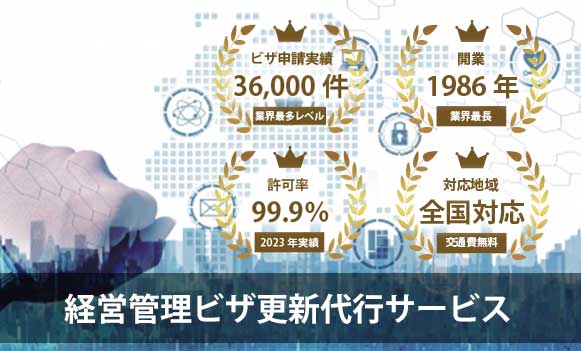
Business Manager Visa Renewal Guide After the Law Revision
We explain points to obtain a three-year renewal, cases that are approved or denied, and required documents for Business Manager visa renewal.
7. FAQ: Business Manager Visa 2025 Law Revision
It takes effect on October 16, 2025. Applications accepted before the effective date will, in principle, continue to be reviewed under the former criteria.
Renewals within three years from enforcement (~2028/10/16) may be holistically judged even if the new criteria are not fully met, considering business substance and prospects. After three years, conformity to the new criteria is required.
For corporations, by paid-in capital (or total equity); for sole proprietors, by the total amount invested in securing a place of business, personnel costs, capital expenditures, etc. Consistency of evidence is critical.
Either the applicant or a full-time employee can satisfy it. In practice, it is also possible to meet it by hiring an N2 holder.
It is verification by an SME Management Consultant, CPA, or Licensed Tax Accountant of feasibility in profitability, cash flow, hiring/social insurance, and permits/licenses. Consistency between figures and supporting materials is emphasized.
8. Summary of the 2025 Business Manager Visa Law Revision
While it is estimated that roughly 41,600 foreign nationals reside in Japan under the Business Manager status, only a subset of companies have JPY 30 million or more in capital at establishment. The ministerial revision (effective 2025/10/16) shifts toward requiring substantive management by introducing not only a major increase in the capital benchmark but also requirements such as one full-time employee, a Japanese-language structure at B2 (JLPT N2-equivalent), and expert verification of business plans. Consequently, new entries are expected to decrease in the short term, with a clearly higher entry hurdle.
On the other hand, for entrepreneurs who meet the requirements, initial gates such as credit screening, account opening, property leasing, and supplier credit become easier to pass, raising evaluations (creditworthiness) by financial institutions and partners. Since governance in HR, labor, social insurance, tax, and permits/licenses is assumed from immediately after launch, it also leads to building a highly sustainable and reproducible management base. This is truly a policy shift “from quantity to quality.”
However, designing JPY 30 million in capital and maintaining a full-time hire are heavy burdens for those aiming for a small start, creating a side effect of being less able to begin in a lean, test-and-learn manner. It is indispensable to present a unified set of documents on common issues across finance, real estate, and immigration—source of funds and capital nature, business reality of the office, and KYC (identity checks). Moreover, since 2025/7/10, renewal examinations have also become stricter, with careful checks of explanations of actual activities, performance of public dues (taxes/social insurance), and the degree of involvement by directors.
Transitional measures for up to three years are provided for current residents; while holistic judgments will be made in the interim even if the new criteria are not fully met, renewals after three years must meet the new criteria. Therefore, the key points are “front-loaded responses with renewals in mind”: schedules for capital increases, securing N2-equivalent talent, outlook for obtaining permits/licenses, and preparation for expert verification.
In sum, this revision is designed to trade “fewer entries” for “higher retention, creditworthiness, and employment quality.” While the number of foreign entrepreneurs may decrease in the short term, companies that do enter meeting the requirements will likely have greater scale and sustainability, increasing their substantive contribution to Japan’s economy. While monitoring future operational guidance and examination practices, the shortest route to success is to solidify early the three points of capital planning, employment structure, and business plan (expert verification). By consulting experts from the preparation stage, you can obtain proposals for the shortest path and risk-mitigation measures for each case.
Sources & References (Primary Information)
- Immigration Services Agency of Japan | Status of Residence “Business Manager”
- Immigration Services Agency of Japan | Notice on the Business Manager Visa Law Revision (Press Release)
- Official Gazette (e-Kanpo) | Ministry of Justice Notifications / Immigration-related Ministerial Ordinances (Text of Revisions)
- e-Gov Law Search | Enforcement Regulations of the Immigration Control and Refugee Recognition Act (Revised Provisions)
- Immigration Services Agency of Japan | Examination Guidelines & Handling Materials (PDF)

Gyoseishoshi Hojin ACROSEED
Managing Partner: Makoto Sano
Japan Federation of Administrative Scriveners Associations (Registration No. 01080685)
Tokyo Administrative Scriveners Association (Member No. 4568)
Founded in 1986
Now in our 39th year, a two-generation firm dedicated to immigration law for foreign nationals.
Administrative Scrivener since 2001
23 years of experience as an international administrative scrivener.
Appointed to the International Affairs Committee, 2023
Contributing to the development and training of administrative scriveners in the Tokyo Administrative Scriveners Association.
Track Record
ACROSEED’s legal services are trusted by more than 1,000 companies, including listed and global firms. We also have extensive experience as lecturers for corporate seminars and as authors/contributors on immigration topics.
Related services

Investor/Business Manager Visa
Not only those living in Japan, but also those living overseas with no collaborators in Japan can obtain a business manager visa and start their own business!
Google Reviews
Since opening our practice in 1986, we have been involved in consulting on visa applications for foreigners for nearly 40 years as an immigration lawyer.
Telephone consultation, email consultation, online consultation, and consultation at our office are available.