Are There Any Important Points to Consider When Renewing a Spouse Visa?
Last Updated:

When renewing a Spouse of Japanese National visa, many people assume that “it will be fine because it was approved before.” However, in practice, the renewal stage is when many critical screening points arise. If you accidentally miss your period of stay, even a valid and genuine marriage may result in overstaying, which can lead to revocation of status and have a serious negative impact on future permanent residence applications.
Each time a spouse visa is renewed, immigration authorities reassess whether a stable marital relationship is still ongoing and whether a solid living foundation in Japan has been established. In recent years, there has been a stronger tendency to strictly scrutinize marriages that appear formal or lack substantive reality, so even renewal applications require careful preparation.
- Key Concepts for Obtaining a 3- or 5-Year Spouse Visa
- Application Timing and Basic Rules for Spouse Visa Renewal
- Cases Where Renewal Is More Likely to Be Difficult
- Importance of “Living Conditions” Such as Taxes and Social Insurance
- Case Example: Obtaining a 3-Year Period upon Spouse Visa Renewal
- Why Careful Preparation Is Essential Even for Renewals
- Support System of ACROSEED Immigration Lawyer's Office
1. Key Concepts for Obtaining a 3- or 5-Year Spouse Visa
Many applicants hope to obtain the longest possible period of stay, namely five years. However, cases where a five-year period—or even three years or more— is granted at the very first renewal are relatively limited. Generally, immigration authorities tend to favor situations where a certain number of years have passed since marriage, cohabitation has been stable, and overall life stability can be objectively demonstrated, such as having children of compulsory school age.
Moreover, for those aiming to apply for permanent residence in the future, having a 3- or 5-year period of stay is, in principle, an important prerequisite. Therefore, renewing a spouse visa should not be viewed as a mere extension, but rather considered strategically as a step toward permanent residence.
2. Application Timing and Basic Rules for Spouse Visa Renewal
Applications for spouse visa renewal can be submitted starting three months before the expiration date of the current period of stay. Rather than rushing preparations at the last minute, it is important to prepare documents well in advance.
The application form must clearly state the desired period of stay (3 years or 5 years). Although the form notes that “the granted period may differ depending on the examination results,” in practice, applications that only request a one-year period are rarely granted three or five years.
If you wish to obtain a longer period of stay, it is essential to clearly indicate “5 years requested” or “3 years requested” and to support that request with explanatory documents that demonstrate the basis for a longer stay.
3. Cases Where Spouse Visa Renewal Is More Likely to Be Difficult
When renewing a spouse visa, one situation that often requires particular caution is when the couple is living separately. Because the Spouse of Japanese National visa is, in principle, based on the assumption that “the married couple lives together and shares daily life,” immigration authorities will carefully examine whether a genuine and ongoing marital relationship still exists when separation continues.
For example, if the registered addresses on resident records differ, living expenses are managed separately, or daily interaction cannot be confirmed from submitted documents, immigration authorities may question not only the difference in address but the substantive reality of the marriage itself.
That said, living separately does not automatically mean that renewal will be unfavorable or that only a short period of stay will be granted. In practice, when there are reasonable and objectively explainable reasons, many renewal applications are approved without issue.
Typical examples include:
- Temporary job transfers or solo assignments of either spouse
- Temporary separation due to caregiving or nursing of distant relatives
- Living apart on weekdays and together on weekends due to work schedules
- Temporary separation shortly after marriage while preparing housing
In such cases, it is important to explain, based on concrete facts, why separation is necessary, when it began and for how long, and whether there is a plan to resume cohabitation.
Even during separation, submitting materials that demonstrate the continuation of the marital relationship can help reassure immigration authorities, such as:
- Transportation receipts or IC card histories showing regular visits
- Photographs taken together, preferably showing a clear timeline
- Call logs or message excerpts showing daily communication
- Records of financial support or shared household expenses
These materials are effective in objectively demonstrating that “living separately does not mean a marriage in name only.” Because renewal applications also examine how circumstances have changed since the previous application, the longer the separation continues, the more important clear and careful explanations become.
Even if you are living separately, properly organizing the circumstances and preparing reasonable explanations and supporting documents can still lead to a successful spouse visa renewal and even help you aim for a 3- or 5-year period of stay in the future. If you feel uneasy because of separation, we strongly recommend preparing early for your renewal application.
If “one-year renewals continue,” “there is separation, job change, or income fluctuation,” or “you are unsure how to explain your situation,” we provide clear guidance on key renewal points and how to organize supporting documents.
English and Chinese support available.
Email Consultation 03-6905-6371
Service Details & Fees (Spouse Visa Renewal Support)
4. Importance of “Living Conditions” Such as Taxes and Social Insurance
In spouse visa renewal, not only the marital relationship (cohabitation and interaction), but also whether you can maintain a stable life in Japan is a key examination point. In recent years, particular emphasis has been placed on compliance with public obligations, such as resident tax, income tax, pension, and health insurance.
It is important to note that these checks are not limited to the foreign spouse alone. Because the spouse visa is based on “living in Japan as a married couple,” immigration authorities often assess whether the household as a whole is properly fulfilling public obligations. Even if the Japanese spouse has unpaid or delayed payments, this may negatively affect the examination.
Especially when the Japanese spouse’s income and tax status are evaluated as the primary financial supporter, poor payment records may be interpreted as instability in the household’s living foundation.
1. What Matters Is Not “Whether You Paid,” but “Whether You Paid on Time”
Even if the total amount is eventually paid, late payments can result in a significant negative evaluation. In other words, “paying eventually” is not enough; timely and proper compliance is crucial.
Examples that require caution include:
- Resident tax forgotten and paid in a lump sum after a reminder
- Unpaid periods of national pension or health insurance without exemption procedures
- Installment payments with unstable payment records
- Delays in switching social insurance after job changes or resignation
While temporary mistakes or circumstances are not uncommon, immigration authorities assess whether applicants continuously follow social rules required for mid- to long-term residence. If delays exist, it is important to prepare clear explanations of the reasons and improvement measures.
2. If You Aim for Permanent Residence, Be Especially Careful from the Renewal Stage
If you plan to apply for permanent residence in the future, extra caution is required from the renewal stage. In permanent residence screening, compliance with taxes, pension, and health insurance is treated as a core part of the “public interest requirement.” If there are unpaid or delayed payments, the risk of denial increases significantly (or the application timing may need to be postponed).
Therefore, spouse visa renewal should be prepared not only as an extension of your current stay, but as a process of building long-term credibility toward permanent residence.
3. Checklist to Review Before Renewal (For Both Spouses)
- Resident tax: no unpaid balance and payments made on time
- Income tax: no missing or delayed filings/payments if applicable
- Pension: no unpaid periods (including exemption or deferral procedures)
- Health insurance: no unpaid premiums
- After job change, resignation, or move: no missed notifications or procedures
If unpaid or delayed payments are discovered, leaving them unresolved poses the greatest risk. Complete payment (or proper exemption procedures) should be made promptly, and explanations—including preventive measures such as automatic bank transfers— should be prepared if necessary.
Although it is easy to think “renewal is the same as last time,” public obligation records accumulate year by year. Careful preparation at each renewal leads to a greater chance of obtaining 3- or 5-year periods of stay and ultimately permanent residence.
5. Case Examples of Obtaining a “3-Year” Period upon Spouse Visa Renewal
In renewal examinations, stability of life and continuity of the marital relationship are evaluated and influence the granted period of stay (1 year, 3 years, etc.). This section introduces cases where a 3-year period was granted upon renewal.
 |
VOL.179 Ms. Qin (China) |
| [Approved Case] Obtaining a 3-Year Period upon Spouse Visa Renewal |
 |
Client (from Google Reviews) |
| [Approved Case] Obtaining a 3-Year Period upon Spouse Visa Renewal |
View All Spouse Visa Approval Cases
Client Reviews from Google
6. Why Careful Preparation Is Especially Important for Renewals
If you assume that “renewal is easy” or that “the same documents as last time are sufficient,” you may find yourself repeatedly granted only one-year periods, or drifting further away from future permanent residence eligibility.
Spouse visa renewal is a critical procedure that can be seen as a branching point toward long-term residence or permanent status. Carefully preparing each renewal is the most reliable way to secure stable residence and expand your future options.
At ACROSEED Immigration Lawyer's Office, we provide specialized renewal support aimed at obtaining a 3-year period for clients who previously received only a one-year period. We offer expert advice on which points should be strengthened based on your individual circumstances.
Spouse Visa Renewal Application Support Service
A specialized support service for applicants who received a one-year period at their last renewal and aim to obtain a 3-year period.
If “one-year renewals continue,” “there is separation, job change, or income fluctuation,” or “you are unsure how to explain your situation,” we clearly explain key points and how to organize supporting documents.
English and Chinese support available.
Email Consultation 03-6905-6371
Service Details & Fees (Spouse Visa Renewal Support)
7. Support System of ACROSEED Immigration Lawyer's Office
A spouse visa application is not only about collecting documents. It is essential to proactively align the entire set of materials by anticipating the points Immigration is likely to check.
From the initial planning stage, our office identifies potential risk factors and provides end-to-end support—covering submission order, supporting documents, and the overall strategy for the Statement of Reasons.
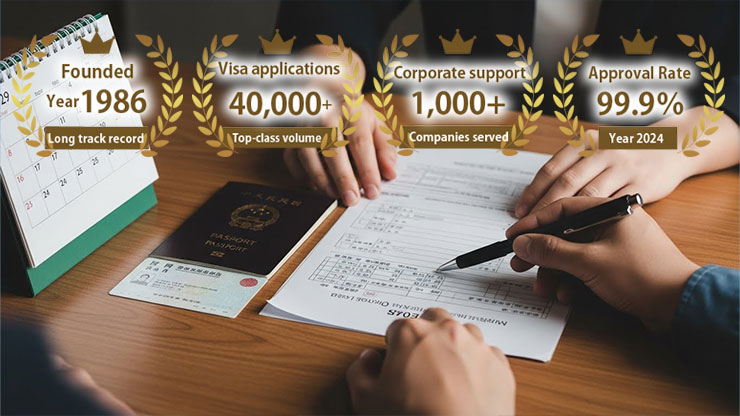
Established in 1986, with over 40,000 cases
We apply long-term examination trends and corporate-standard know-how directly to your application.
Learn moreExperienced specialists with 10+ years are involved in key judgments
We understand the examination points and can provide consulting that reduces denial risk.
Learn moreThe judgment behind a 99.9% approval rate (2024)
If we determine approval is extremely unlikely, we will tell you honestly.
Learn moreNationwide support: Managed mainly via email and online. Clients outside the area receive the same quality of support.
Multilingual support: Consultations available in English and Chinese.
Clear progress tracking: Check application status and required documents through an online system.
Support for difficult cases: Extensive experience with cases likely to face closer scrutiny, including re-applications after denial.
Transparent fees: Clear fee structure designed to minimize unexpected additional charges.
Support even after a denial: If denied, we provide a free re-application and thorough support until approval.
Information security: We properly manage personal information under operations based on ISO27001.
View the full list of 9 reasons why ACROSEED is chosenACROSEED’s Track Record
View Customer Testimonials
Free Consultation

ACROSEED Immigration Lawyer's Office
Representative Administrative Scrivener
Makoto Sano
1998 Graduated from Aoyamagakuin University
2001 Registered as an administrative scrivener
He has Over 20 years of experience as an international administrative scrivener, specializing in foreign employment consulting and residence procedures for foreign residents in Japan.
Click here to see information about his business achievements
Click here to see books he has authored
Pages Often Read Together When Applying for a Spouse Visa of a Japanese National
![[FY2025 Edition] Spouse Visa of a Japanese National (Marriage Visa) Application Guide](https://english.visajapan.jp/images/haigusha_title.jpg)
[FY2025 Edition] Spouse Visa of a Japanese National (Marriage Visa) Application Guide
An administrative scrivener explains the requirements for obtaining a spouse visa (marriage), working under a spouse visa, applying for permanent residency from a spouse visa, what happens in the event of divorce under a spouse visa, required documents, and more.
[FY2025 Edition] Spouse Visa of a Japanese National Renewal Procedures Guide
Renewal procedures for a Spouse Visa of a Japanese National (Marriage Visa). An administrative scrivener explains the required document checklist, how to avoid denial cases, and key points to prove eligibility for obtaining a 3-year or 5-year period of stay.

Applying for Permanent Residency from a Spouse Visa of a Japanese National
At ACROSEED, we have a proven track record not only with first-time spouse visa applications, but also with cases that were denied multiple times when filed by the applicant alone, as well as procedures for those with past legal violations or a history of overstaying—across a wide variety of situations.
For More Detailed Questions About the Spouse Visa System
Please explain the requirements for obtaining a Spouse Visa of a Japanese National in detail
Periods of stay for a Spouse Visa of a Japanese National: Differences between 1 year, 3 years, and 5 years
Required documents & Statement of Reasons for a Spouse Visa of a Japanese National: Key examination points and preparation tips (Latest Edition)
How to invite a foreign spouse living overseas to Japan with a COE
Can we apply for a Certificate of Eligibility while both spouses remain overseas?
Changing from a short-term visa to a Spouse Visa of a Japanese National: General rules and exceptions
How to change from a student/work visa to a spouse visa
My spouse visa application was denied (COE not issued). Can I re-apply?
Since opening our practice in 1986, we have been involved in consulting on visa applications for foreigners for nearly 40 years as an immigration lawyer.
Telephone consultation, email consultation, online consultation, and consultation at our office are available.